Esh Winning skylights and rooflights that keep their warmth
Esh Winning is a village in the Deerness Valley, 21.6 road miles south of Newcastle. A new rooflight brings daylight, but it also has to hold its heat, so we start with your roof and finish with the glazing figures.
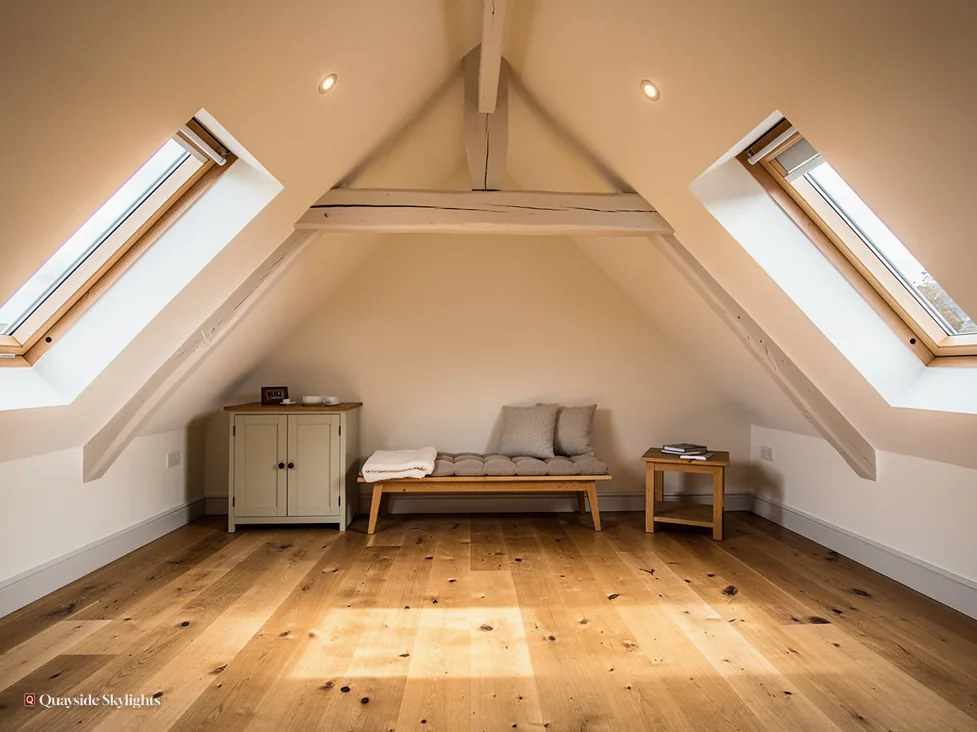
Daylight from overhead, minus the cold patch
A window in a roof changes where warm room air meets cold glass. A bedroom under the slates, a landing with a damp-prone corner or a bathroom full of steam can each gain daylight, and each needs the glazing picked with care. The roof type sets what fits, and the glazing figures set how well the room holds its heat.
Esh Winning rooflights and roof windows
Each service below is an option, and it is the survey that decides which your roof can take. Roof lanterns, Flat roof rooflights, Roof windows, VELUX windows, Electric rooflights, Energy efficient rooflights, Misted rooflight replacement, Walk-on rooflights, Conservation rooflights, Sun tunnels.
Esh Winning, warm glass
Rooflights for Esh Winning homes that stay warm and dry
Four questions that run from the roof into the room: what your roof is made from, which rooflight goes in it, how warmth and condensation are handled, and what comes after the frame is in, including sign-off and the guarantee.
Is the roof over my Esh Winning room slate, tile or flat?
Short answer
Slate on a slope, tile on a slope, or a flat deck over a rear extension are the leading candidates. The roof sets the product, so we identify it first. A village's story is no substitute for looking.
Esh Winning was founded by the Pease family in the 1850s to service a new mine on the Esh Estate, and it sits in the Deerness Valley about five miles west of Durham. That history is interesting, but it does not tell us how your own roof is built. Houses are altered and extended over the decades, so the only reliable way to know is to look.
Slate and tile slopes
Pitched roofs carry slate or tile on battens fixed over rafters. Fit a roof window and a section of covering is removed, with the frame bedded level with the surrounding slope. Slate is thin and handled carefully when lifted around a frame. Tile is thicker and may overlap differently, which changes the flashing. We note the covering at the survey so the right kit is ordered.
Flat roofs on extensions
A kitchen, utility or garage conversion at the back can have a flat roof, made of joists, a deck and a waterproof layer. On a flat roof, the rooflight is raised on an upstand fixed to the deck, and a lantern is a glazed pitched frame mounted on the same upstand. Warmth matters especially here, because the roof is a wide flat surface open to the sky, and the upstand needs insulating as well as sealing.
Everything else
Dormers, lean-tos, porches and bays each carry a small roof of their own. A rooflight can go into any of them, but the pitch and construction differ from the main slope, so each one is matched to a product individually.
A flat or a house
If you live in a flat, the roof may be a neighbour's, or owned by all of you together. Your lease or title records the position. Read it, then have that conversation with the other owner well ahead of any order.
What we bring to this
The point of reading the roof first is that everything after it gets easier. The covering tells us which flashing to order, the structure tells us whether an engineer is needed, and the pitch tells us which windows can open at all. Several of the decisions in the chapters below depend on these early facts.
Our view: name the covering and the structure before anything else, since a fine rooflight in the wrong roof is still the wrong rooflight.
What should go into the roof over my dim Esh Winning room?
Short answer
A roof window suits a sloped roof over a loft room, a sun tunnel suits a bathroom or landing under a loft void, and a flat rooflight or lantern suits a flat extension roof. All meet Part L when specified correctly.
With the roof known, three families of product are left to choose from. We describe each by the room it serves, because that is how people picture them.
A bedroom or study in the roof
Here a roof window gives the strongest light and the best view. Opening styles differ: a centre-pivot swings on a bar across its middle, while a top-hung unit hinges at the head. Sill height decides which sits better in the room. VELUX labels such as MK04 can be read off a datasheet; the first pair of characters is the width and the second pair is the height.
Windowless rooms under a loft void
For a windowless room beneath a loft, a sun tunnel is the discreet route. The roof dome gathers daylight, a mirror-lined tube conveys it, and a diffuser releases it from the ceiling. The room sees a soft panel, not a sheet of glass, and nobody has to open a wide shaft through the loft.
A kitchen or utility with a flat roof
A flat rooflight gives a clear panel over the room, and a lantern adds a glazed pitched shape that spreads the daylight further. Some versions open, some are electric with a rain sensor, and walk-on ones can double as a roof terrace floor. Our range of rooflights for flat roofs shows how they differ.
Why the size matters
Bigger is not automatically better. A very large pane can overheat a south-facing room in summer and lose more warmth in winter, while a smaller one in the right place can light a room well. We weigh the floor area to be lit against the direction the glass faces.
Fixed or opening
A fixed unit has fewer parts and a simpler seal. An opening one lets heat and steam out and fresh air in, which helps a bathroom or a loft bedroom in summer. Electric versions with a rain sensor close themselves when rain starts, which suits a high rooflight that cannot be reached by hand. We set out the choice in the quote with its reasons.
Will a new rooflight leave my room cold or damp?
Short answer
Pick glass that meets the Part L limits, have the frame sealed and insulated round its edges, and keep the room ventilated. A well-specified rooflight need not become the cold surface where condensation gathers.
Condensation begins where cold glass meets a warm room. Moist air from cooking, washing and breathing touches a cold surface, cools quickly and leaves water behind. Any window can do it, but a rooflight faces the sky, which turns cold on a clear night, so the detail deserves attention.
The figures that count
Part L of the Building Regulations sets the limits for new rooflights in existing homes. A rooflight must have a U-value of no more than 2.2 W/m²K, and a roof window no more than 1.4 W/m²K, or achieve WER Band B. A lower number means less heat escapes through the glass. A better-glazed unit has warmer inner surfaces, so condensation has less chance to form on them.
What helps the glass stay warm
- Double or triple glazing, with the gap filled to slow heat flow
- A warm-edge spacer, so the rim of the glass is not the coldest line
- Laminated inner panes, standard over rooms
- An insulated collar or lining around the frame, so the reveal does not become a cold bridge
The reveal and the seal
Some of the damp that gets blamed on glass really starts in the lining. If warm air reaches the cold timbers round the opening, it condenses there. A sealed vapour layer and a well-insulated reveal keep that air in the room. At the survey we study the depth of the roof structure so the lining can be planned around it.
Ventilation still counts
Bathrooms and kitchens give off a great deal of moisture. An opening rooflight lets steam out quickly, and an extractor fan does a similar job. We talk through how the room is used and suggest an opening unit where it would help.
Orientation and blinds
A south-facing slope gathers more sun, which warms a room in winter but can overheat it in summer. A north-facing slope gives a steady, cooler light. Solar control coatings, internal blinds and external blinds each tame the heat in a different way, and the right one depends on how the room is used.
| Item | Limit or step | Where it applies |
|---|---|---|
| Rooflight | 2.2 W/m²K | Flat roofs, lanterns and similar glazing |
| Roof window | 1.4 W/m²K or WER Band B | Pitched roofs over rooms |
| New opening in a roof | Notified to Building Control | Every house or flat where the work is notifiable |
What happens after the frame is in: sign-off, the guarantee and the village's listed buildings?
Short answer
Building Control is notified where the work is notifiable, and a written 10-year workmanship guarantee follows. Flats need planning permission from Durham County Council, and listed buildings need listed building consent.
The fitting is only part of the job. A set of small steps follows it, and each one protects both the house and its owner.
Building Control
Cutting a new opening in a roof is building work. It is notified to Building Control, either the local authority or a registered building control approver. Our team sends the notification whenever the work is notifiable, and the sign-off records that the opening meets the regulations in force.
Planning
On a house, most rooflights fall under permitted development within set limits, and our planning permission guide lays out when that changes. A flat has no householder permitted development, so a new rooflight needs planning permission from Durham County Council. Esh Winning has a Grade II-listed memorial hall, and any listed building needs listed building consent for almost any rooflight, a consent that decides the job.
The guarantee
At the end you are given a written workmanship guarantee that lasts 10 years. It stands beside the manufacturer's own warranty on the unit. File both with the quote and the Building Control paperwork, in case a buyer or a surveyor asks.
Living with the new rooflight
A roof window may call for a blind in strong sun, and a lantern can prompt a second look at the room's ventilation. A pale colour on the reveal bounces more daylight into the room. If the unit opens, learn how it works before the first wet day.
The steps are the same at Ushaw Moor, Brandon and the rest of the valley. Whenever you are ready, book a survey and tell us the name of the dimmest room.
Esh Winning answers on glass, damp and permission
Will a rooflight make my bedroom colder in winter?
Not if the glazing meets the Part L limit for its type and the frame is sealed and insulated round its edge. A modern unit can lose less heat than an old window. The survey looks at the roof structure, and the quote names the glazing it will use.
Why does water form on the glass of my bathroom rooflight?
Steam turns to water wherever it meets a cold surface. Glass with a better U-value stays warmer, so less forms on it. An opening unit or an extractor fan clears the moisture faster. We talk about how the room is used while we survey it.
Is Durham County Council the authority for Esh Winning?
Yes. Esh Winning lies in County Durham, so Durham County Council receives any planning application for a flat and any listed building consent. The national rooflight rules apply in England as a whole.
Do you fit sun tunnels as well as roof windows?
Yes. The windowless landing or bathroom under a loft points to a sun tunnel, and a room with a slope overhead points to a roof window. We weigh both against your house on the visit, then put the decision in the quote.
How should I get in touch from Esh Winning?
A first message can go to 07880 284133 on WhatsApp or to info@quaysideskylightsnewcastle.co.uk; put your address and the room in it. A photograph of its ceiling is useful. The visit itself is free, and your fixed written quote comes afterwards.