Misted rooflights
Replacing misted rooflights in Newcastle upon Tyne
A skylight that fogs between the panes has stopped doing its job, and cleaning will not bring it back. We replace misted rooflights across Tyneside, starting with the house, the roof and the unit you have now.
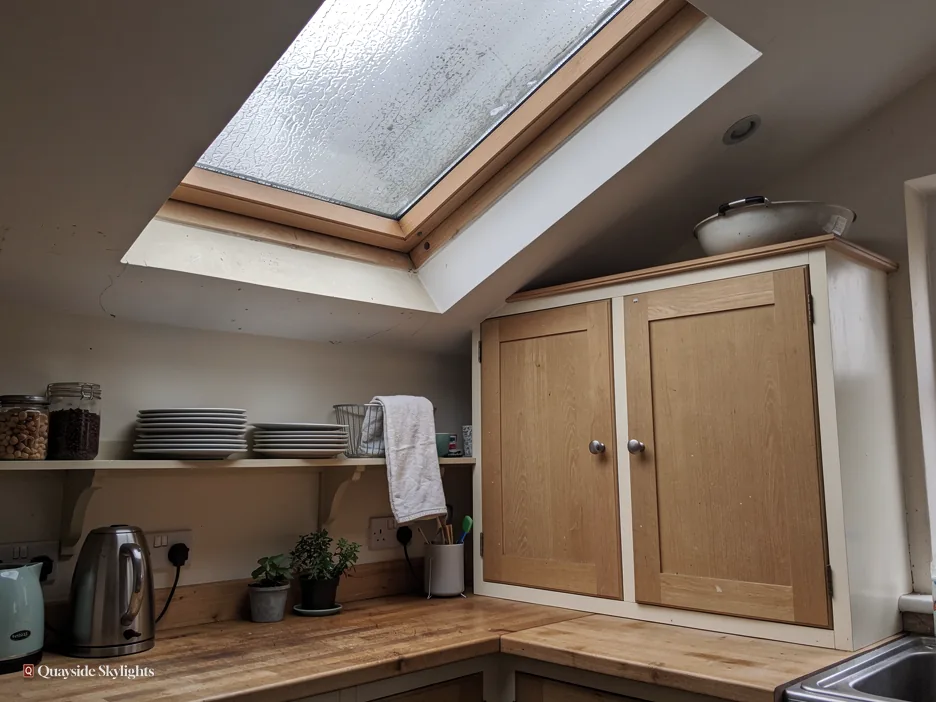
Suits upstairs and downstairs Tyneside flats, terraces and semis with a tired roof window, and extensions or new builds with a flat rooflight that has fogged.
Which house is yours?
Which house is yours?
Upstairs flat
- Who decides
- The upstairs owner, together with the owner of the lower flat if their lease or title reaches the roof void. Read the paperwork and talk first.
- Which rules apply
- A swap into the same opening is one thing; a bigger or higher unit is closer to a new rooflight, and flats have no householder permitted development.
Downstairs flat
- Who decides
- Usually you for a rooflight over your own back offshoot, but the upstairs owner may have rights over that roof. Your title or lease says; check before ordering.
- Which rules apply
- Same opening and similar size is a swap. Anything larger or taller is treated more like a new rooflight, which a flat cannot do under permitted development.
House
- Who decides
- Normally you alone. Check the deeds for restrictive covenants, and the conditions on any earlier planning permission for the roof or extension.
- Which rules apply
- Class C allows a rooflight up to 150mm above the roof plane and no higher than the highest part of the roof. An Article 4 direction can remove it; a listed house needs consent.
Misted, then replaced
What to know before a fogged rooflight comes out
The questions that come up once a skylight has clouded over, in the order a swap tends to run: what the fog means, who has to agree, glass or whole unit, old plastic domes, the new unit itself, flat roofs and extensions, what moves a quote and how the work goes.
My rooflight has clouded over between the panes. Does it really need replacing?
Short answer
Fog or droplets trapped between two panes mean the sealed unit has let air in. Wiping the glass will not reach it. The unit has stopped insulating properly, so the answer is a new unit or a new rooflight.
Clean the glass, dry it, and look again. If the cloudiness is still there, it is inside. That is the sign of a failed sealed unit: two or three panes held a few millimetres apart, with the edge seal now letting damp air in and out. Once that has happened, nothing you can do from the room or the roof will clear it for good.
Misting on the surface and misting inside
Not every foggy skylight is a failed one. Condensation on the room-facing side of the glass is a different problem. It forms when warm, damp air from a kitchen, bathroom or bedroom meets a cold surface, and it wipes away. Droplets on the outside face are just weather. The case we are talking about is a film, a haze or beads of water that sit between the panes and come back the day after you wipe.
To see how the seal gives way, read the guide on what makes the gap fog. Leaving it as it is costs you something.
What you lose while it stays misted
A clouded pane passes less daylight than it should, so the loft bedroom, the landing or the kitchen extension under it looks dimmer and flatter. The room can also feel colder next to the glass, because the insulating gap that made the unit worth having has gone. Over time, the same damp that fogs the gap can leave mineral stains, which are hard to look at every morning.
There is a safety angle too, which we cover separately in whether a fogged skylight is safe to leave. In short, a failed seal does not make a pane fall out by itself, but it tells you the unit has aged and the frame, flashings and fixings deserve a proper look at the same time.
What replacing it involves
There are two routes. One is a new sealed glass unit set into the frame you already have. The other is a whole new rooflight or roof window, frame and all. Which one suits depends on the make, the age and the condition of everything around the glass, and we take that up in the chapter on glass-only against full replacement. You do not need to decide before the survey. The visit costs nothing, and a figure only follows once the roof and the unit have been examined.
What we do ask you to notice beforehand is simple. Which room is it over? Is the haze in every pane or only one? Can you open it? Is the frame timber, white-painted or aluminium? Have you seen staining on the plaster around it? Those answers shape the survey and save a second visit.
Why a clear pane is worth having back
A skylight exists to bring natural light into a room that the walls cannot serve: a landing, a loft bedroom, a bathroom, the middle of a deep kitchen. Daylight from above is bright and even, it reaches further into the room than a side window does, and it changes through the day in a way that people tend to notice only once it has gone dull. A clear, well-insulated replacement gives that back, and it stops the glass being the coldest spot in the room.

Short answer
A like-for-like swap is not the same as cutting a new opening, but who owns the roof still decides who must agree. In a Tyneside flat that is written in your title or lease, so check it first.
Do I need anyone else to agree before a misted rooflight comes out, and does it matter if I live in a flat?
Lifting out a failed unit and dropping a new one into the same gap is not the same job as forming a fresh opening in the roof. Even so, the house you live in sets who has a say, and it is better to find that out at the kitchen table than on the day a delivery arrives.
Flats and who owns the roof
A Tyneside flat is two flats under one roof, each with its own front door. Whether the upstairs owner holds the roof, the roof space or just the loft hatch is written into each flat's own title or lease. We never assume it. Check your own documents, speak to the other owner and agree the work before an order goes in. If the rooflight lights an upstairs landing or a loft room, that is usually a short conversation. If it sits over a shared stair or a back offshoot, it is worth having in writing.
Planning is the other half. Flats and maisonettes have no householder permitted development, so a new rooflight on one needs planning permission from the council. A like-for-like swap is not a new rooflight, but changing the size, the projection or the position can move the job into that territory. How the rules differ by house type is laid out in the planning permission guide.
Houses, terraces and conditions
On a house, a rooflight is permitted development if it projects no more than 150mm beyond the plane of the roof slope and sits no higher than the highest part of the roof. On a side-elevation slope the whole window must be obscure-glazed, and non-opening unless the opening parts are more than 1.7 metres above the floor of the room. A house inside a conservation area still has that right unless something else removes it. An Article 4 direction, or a condition on an earlier planning permission, can. A listed house keeps Class C on the planning side, but almost any rooflight on it needs listed building consent, and that decides the job.
What we check on the survey
When we visit, we examine the unit, the roof around it and the house type, and we tell you plainly whether the job is a swap or something larger. Where the work is notifiable, we handle the Building Control notification, through the local authority or a registered building control approver. Our fixed written quote arrives once the survey is done, and it stands unless the work changes.
If you tell us up front whether you own a flat or a house, which floor you are on and who else shares the roof, the survey goes faster and the answers are firmer.
Can the glass be replaced without replacing the whole rooflight?
Short answer
Sometimes. If the frame is sound and the unit is a separate sealed pane that can be sourced to size, new glass can do. If the frame, seals or flashings have aged, a whole new rooflight is the better job.
It is a fair question, because the glass is the failed part and a pane is a smaller item than a frame. It depends on what surrounds the glass, and we only know that once we are on the roof.
When new glass makes sense
Some roof windows and flat rooflights are built so the sealed unit can be taken out and a new one fitted to the same frame. If yours is one of them, if the frame is square, dry and sound, and if the failed unit is the only fault, a new pane can be the neat, proportionate answer. It also keeps the existing frame and finish, which counts where you want the roofline to look as it did.
The catch is sourcing. A unit has to match the rebate, the thickness, the spacer and the glass build. Glass over a bedroom or kitchen is usually laminated on the inside, so the new pane should be too. Where the original maker no longer lists the part, or where the frame is a one-off, glass alone may not be on the table.
When the whole rooflight should go
A misted unit often comes with other signs of age: a timber frame that has swollen, paint that has failed, a gasket that has gone hard, flashings that have lifted at the edge. Putting new glass into that frame buys a clear pane in a tired setting. A whole new unit resets the clock on all of it and lets us choose a better thermal build. A separate guide, choosing between glass and a full unit, works through the decision in more detail.
How we help you decide
Up on the roof we study the unit, test the frame, and check how it meets the roof covering. We then give you a fixed written quote for the route that suits, and where there is a sensible alternative we tell you about it. Whichever route you choose, a written guarantee on our workmanship runs for ten years.
The table gives the shape of the choice. The survey fills in the answers for your roof, and the answers can differ even between two neighbouring houses of the same age.
| Question | New glass only | Whole new unit |
|---|---|---|
| Frame condition | Sound, square and sealed with no soft or swollen timber | Tired, warped, stained or hard to weatherproof again |
| Insulation after the job | New pane and old frame together | Set by the new frame, glass and fixings together |
| Fit and size | Pane made to match the existing rebate | Unit chosen to suit the opening and the house |
| What it disturbs | Mostly the glass and its beads or clips | Frame, flashings and finishes around the opening |
| When it suits | Young frame, one failed unit, sound surroundings | Older unit, several faults, or a change in specification |
My rooflight is an old plastic dome that has yellowed and gone cloudy. Can it be swapped for glass?
Short answer
Usually yes, where the roof and the opening suit it. A discoloured polycarbonate or GRP-framed dome is a candidate for a glass rooflight, but the upstand, the opening and the planning position all need a look first.
Older flat roofs, garage conversions, rear offshoots and some loft extensions carry plastic dome rooflights. They were cheap and quick to fit, and some have been up there a very long time. Sun and weather do not treat them kindly.
What ageing plastic looks like
Polycarbonate and acrylic domes yellow, turn chalky and craze with fine cracks as they age. A double-skin dome can mist between the skins in the same way a glass sealed unit does. A dome with a GRP kerb can also open up at the join between kerb and roof covering. When we survey one, we look at the skin, the upstand it sits on and the flashing or covering around it, not just the dome itself.
Brittle plastic needs care because it is hard to fit anything on or around it without cracking it further. That alone is a reason to plan the replacement rather than wait for a winter frost to decide the timing.
Why glass is a good upgrade
A glass flat rooflight passes more usable daylight, keeps its clarity for longer, and can be specified with better insulation than a thin plastic skin. It looks neater from inside, with no yellow cast, and it can be built to a thermal standard that a dome seldom reaches. The Part L limit for a rooflight in an existing dwelling in England is a U-value of 2.2 W/m²K, and a glass unit specified for the job can meet it.
There are conditions. The kerb has to be sound and level, and its height needs to suit a flat rooflight, since manufacturers set minimum upstand heights, commonly around 150mm above the finished roof. If the existing kerb is too low or in poor shape, it is built up as part of the job. Our answer page on swapping a plastic dome for a glass rooflight covers the practical steps.
The opening and the rules
If the glass unit sits in the same opening with a similar footprint, the job is a swap. If the new unit is larger or sits higher, it stops being a simple swap, and the rules for your house type come into play. We flag that on the survey so there are no surprises in the quote.
Use the checklist to spot what you can see from below before we visit. It is not a diagnosis, but it tells us where to look first.
Look at the dome before the survey
- Is the plastic yellow, chalky or crazed with fine cracks across the surface?
- Does it feel brittle or flex where you press it from inside?
- Is the kerb around it timber, concrete or a moulded upstand?
- Is there water between the two skins, or staining on the ceiling below?
- Does the room under it get hot in summer or feel cold in winter?
Short answer
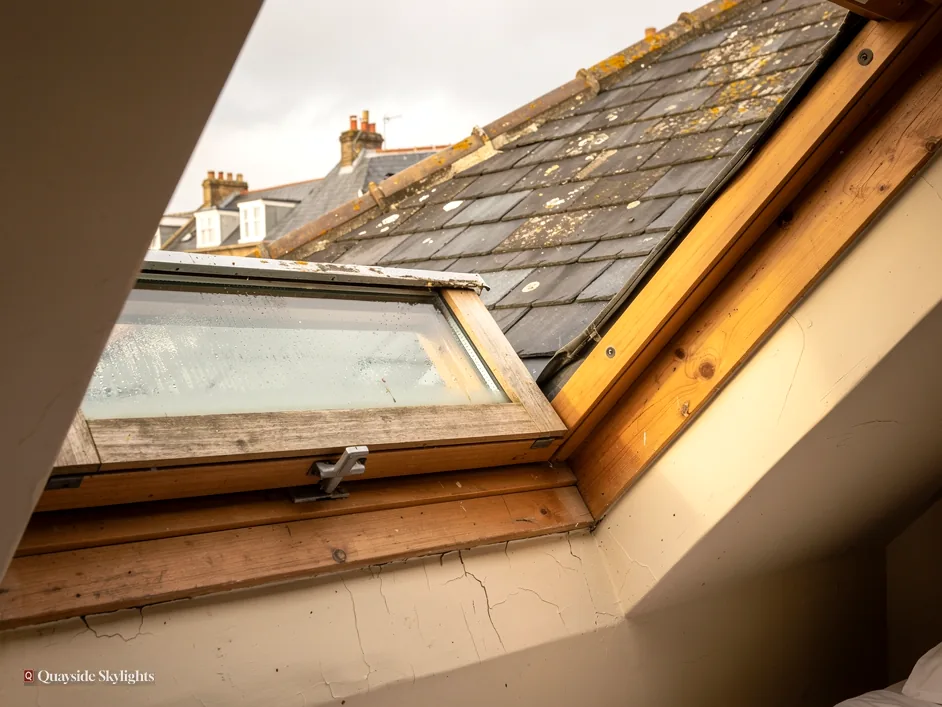
Choose for the room and the roof. A modern unit uses insulating glazing, laminated inner panes and a frame suited to the opening, which helps with warmth, daylight and condensation. Opening versions add fresh air.
What should the replacement be, and will it keep the room warmer and drier?
A replacement is a chance to put right what the old unit got wrong. If the loft bedroom was stuffy, the kitchen extension hot in July or the landing dim, say so. The unit we recommend is chosen for those problems.
Roof window or rooflight
On a pitched roof, the replacement is usually a roof window. These are made in standard size codes by VELUX and other manufacturers. Size codes such as MK04 put the width in the two letters and the height in the digits, so a match can often be read off the label on the old frame. On a flat roof, the replacement is a flat rooflight, either fixed or opening, sometimes with a bespoke glass build cut to suit an awkward opening. Where a standard size does not fit, a made-to-measure unit is possible, and we flag it when we visit.
We fit roof windows from the VELUX range and from other makers, and we recommend the manufacturer's range that suits the roof pitch and the room. Our service page on VELUX roof window installation covers that range in detail.
Insulation, daylight and condensation
The limiting U-value for a roof window in an existing dwelling is 1.4 W/m²K (or WER Band B), and for a rooflight 2.2 W/m²K. A modern sealed unit, carrying a low-e coating and a warm-edge spacer, performs far better than a failed one, and better than an old unit of the same size. A better U-value means a warmer pane, less condensation on the room side and a smaller draught of cold air falling from the glass in winter.
Daylight is the other gain. A clear, well-glazed unit lets in the natural light the room was meant to have. In a loft room, a kitchen or a windowless landing, brighter surfaces and a more even spread of light change how the space is used. We never put a figure on it, because it depends on orientation, size and the room itself.
Ventilation and fresh air
If the old rooflight was fixed and the room felt close, a replacement that opens brings in fresh air and lets steam out of a bathroom or kitchen. Electric and rain-sensing versions suit rooflights that are out of reach. Our service on electric and opening rooflights explains the choices.
The verdict card sums up our approach. Specify well once, and the unit should not be back in the same state for a long time.
Our view: fit the best-insulated unit that suits the opening and the house, and choose one that opens if the room needs fresh air.
The rooflight is on a flat roof over an extension. What else gets looked at when it comes out?
Short answer
The kerb, the roof covering and the flashings around the unit. A new rooflight depends on the upstand and weatherproofing it sits on, so those are checked and, where needed, reformed as part of the job.
A flat rooflight over a kitchen extension or garden room works hard. It takes the sun, the rain pooling around it and the movement of a roof that expands and contracts. When it fogs, the first suspicion is the unit. The second should be the details beneath and around it.
Kerbs, upstands and watertight detailing
A flat rooflight sits on an upstand, often a timber or insulated kerb, and the roof covering is dressed up and over it. If that upstand has rotted or sunk, the new glass will sit on a poor base. Manufacturers set minimum upstand heights, commonly around 150mm above the finished roof, and a lower kerb risks water finding its way past the weathering. Where an upstand is too low or damaged, we build it up so the replacement is weatherproof from day one.
The same goes for flashing on a pitched roof window. Lead or purpose-made flashings need to lap correctly with the tiles or slates, and that is something we cannot judge from the room. A ceiling stain makes people distrust the flashing first, so it is worth being clear about what we look at. Our service on flat roof rooflights describes how we approach the covering and the kerb together.
Insulation and the extension below
On an extension, the rooflight is part of the thermal envelope. A new unit with a good U-value cuts the heat lost through what is often a large area of glass. We also look at how the insulation meets the kerb, because a gap there can bring cold and condensation straight back to the room, even with a perfect pane.
In a new-build home or a more recent extension, the original unit may have been installed to a standard that has since moved on. A replacement is a fair moment to bring the specification up to date.
Access and sequence
Working on a flat roof involves reaching the roof safely, lifting out the old unit and getting a heavy new one up. We plan access at the survey and tell you what we need from you. The page on the length of a swap gives a realistic sense of what affects the day.
When we finish, the opening is watertight, the covering and new unit work as one, and the rooflight should not fog again next winter.
Glass for people to walk or sit under
Some flat rooflights sit over a living space where the sun is strong, such as a south-facing garden room. In those rooms a solar control coating on the outer pane, or a tint, keeps the glare and heat in check without darkening the room much. Let us know what the room is for and which way the roof faces, and we choose the glass to suit it.
What decides the price of replacing a misted rooflight if there is no figure here?
Short answer
The size and type of unit, the access to the roof, the condition of the kerb or frame around it, and whether the opening changes. We price after the free survey, with a fixed written quote.
Prices for rooflight work vary a great deal from one roof to the next, and a number on a web page would mislead more often than it helped. What we can do is explain what pushes the figure up or down, so you can read a quote with confidence.
The unit itself
Size is the first driver. Larger glass costs more to make, to carry and to lift. Specification is the second: laminated inner panes, solar control coatings, tinted or self-cleaning outer glass, and opening or electric versions each add something. A standard size from a manufacturer's range is usually more economical than a made-to-measure unit built for an unusual opening, though the made-to-measure unit may be the only one that fits.
The roof around it
The condition of what surrounds the glass matters just as much. A frame that is sound allows a simpler job. A kerb that has to be rebuilt, flashings that need re-dressing or a covering that has aged around the opening all add work. Access also counts: a ground-floor extension roof is easier to reach than a steep slate roof three storeys up.
See our cost guide for how we explain pricing across all our services, again without figures.
How the quote works
We visit for free, look at the roof, the unit and the room beneath it, and then give you a fixed written quote. The written figure holds, unless you choose a bigger unit or a different spec. Because we survey first, we are not guessing at the roof, and neither are you.
If you have more than one misted unit, tell us. More than one rooflight on the same roof can be assessed at the same survey, and that makes it easier to decide whether to replace them together or stage the work.
Use the lists as a guide to what your own quote is likely to reflect. If a quote you receive from anyone does not explain which of these it is allowing for, ask them to say.
What moves the price
Keeps it lower
- A standard roof window size that matches the existing opening
- New glass only, into a sound frame
- Easy, safe access to the roof or the room underneath
- A sound kerb or flashing that needs little work
- Several units of the same size on one roof
Pushes it higher
- A large, bespoke or made-to-measure unit
- Full replacement with a new frame and flashings
- Awkward access or a high, steep roof
- A rotten upstand or damaged covering that must be rebuilt
- A change to the size or position of the opening
These are factors, not figures. The price follows the survey.
What happens between the first message and a clear new pane, and which areas do you cover?
Short answer
A free survey, a fixed written quote, the Building Control notification where the work needs one, the swap itself and a written 10-year workmanship guarantee. We cover Newcastle and 30 road miles around, from the coast to the Tyne valley.
It helps to know how the whole thing runs before you commit. The job in order, from first message to a clear pane.
From first message to survey
You contact us on WhatsApp at 07880 284133 or by email, or use the form on the quote page. Tell us the house type, the room under the rooflight, and what you can see. A photo of the haze and of the frame helps. We then arrange a free survey. The visit covers the unit, the roof around it, the room beneath and the access, and we ask about ownership if you live in a flat.
Quote, notification and the swap
Once we have surveyed, a fixed written quote follows. When you accept, the unit is ordered, and where the work is notifiable we handle the Building Control notification through the local authority or a registered building control approver. On site, the old unit is lifted out, the upstand and opening are made ready, the new one goes in and is weathered, and the internal finishes are made good around the frame.
Access, unit type and the state of the roof all affect how long the work takes, which is why we talk it through beforehand. The answer on timing for a swap goes through what affects the schedule.
Guarantee and the finished job
A written guarantee on our workmanship runs for ten years. It covers the installation, and it sits alongside the warranty the manufacturer gives on the unit itself.
Where we work
We work across Newcastle upon Tyne and 30 road miles around it. That takes in Gateshead, North Tyneside and South Tyneside, Sunderland and Durham, and south-east Northumberland including Morpeth, Cramlington and Hexham. Our areas page lists the towns. Residential homes come first, and small commercial roofs are welcome too.
The verdict is simple. If someone offers a price without seeing the unit, ask how they can know what they are quoting for.
Our view: see the unit before naming a price, then put the price and the work in writing.
Read more before you decide
- GuideWhy Rooflights Mist Up Between the PanesHow a sealed rooflight unit lets in damp air, and what a misted pane tells you.
- GuideNew Glass or a Whole New Rooflight?When a new sealed unit in the old frame makes sense, and when the whole rooflight goes.
- AnswerHow Long Does Swapping an Old Rooflight Take?The stages between survey and finished swap, and what stretches or shortens each.
- AnswerCan a Plastic Dome Rooflight Be Swapped for Glass?Whether a plastic dome can give way to flat glass, and what the kerb and rules decide.
- AnswerIs a Misted Rooflight Still Safe?Why a fogged sealed unit is usually a comfort problem, and what would make it a safety one.
Details people check before they book a swap
How do I tell if a rooflight has failed or is just damp with condensation?
Wipe the room side of the glass. If the cloudiness clears, it was surface condensation, which is a ventilation matter. If a haze, film or beads of water remain between the panes after wiping, the sealed unit has gone and the glass needs replacing. The misting guide explains the signs.
Do you fit VELUX roof windows?
Yes. We fit roof windows from the VELUX range and from other manufacturers, choosing the make that suits the roof pitch, the size code of the opening and the room. The survey settles which unit fits your roof and what it needs around it, so you know what is going in before you accept the quote.
Will a new rooflight let in more daylight than my old one?
A clear, modern unit passes more natural light than a fogged one, and a well-specified glass pane keeps its clarity. How much brighter the room becomes depends on size, orientation and what shades the roof, so we do not put a figure on it. We talk through options at the survey.
Can you replace one misted rooflight on a roof that has several?
Yes. Each unit stands alone, so one can be replaced while others stay. We will look at all of them on the survey, because if the others are the same age and make, they may be close to failing too. You can then decide whether to do them together or stage the work.
Is a made-to-measure rooflight possible for an odd-sized opening?
Often, yes. Where a standard size does not match the opening, a bespoke glass unit or flat rooflight can be built to the measurements taken at the survey. It may take longer to make, so we tell you when we quote. Standard sizes remain an option where they fit.
Will you tell me if the swap needs planning permission?
Yes. A like-for-like swap is a different job from a new rooflight, but a larger or higher unit can change that, and flats have no householder permitted development. We say at the survey which side your job falls on. The planning permission guide has the rules for each house type.
What does the 10-year guarantee cover?
It is a workmanship guarantee, in writing, covering the installation we carry out. It sits alongside whatever warranty the unit manufacturer provides on the product itself. The details are written into your quote paperwork, so you can read exactly what is covered before you accept.
How do I start the process?
Message us on WhatsApp at 07880 284133, email info@quaysideskylightsnewcastle.co.uk, or fill in the quote form. Say which house type you have, which room the rooflight is over and what you can see. We arrange a free survey and send a fixed written quote afterwards.