Warm skylights and rooflights for Willington homes
Willington lies in County Durham, 23.5 road miles south of Newcastle, in the Pennine foothills near the River Wear. Our rooflights go in with the glazing limits for existing homes in mind, so the room gains light and stays comfortable.
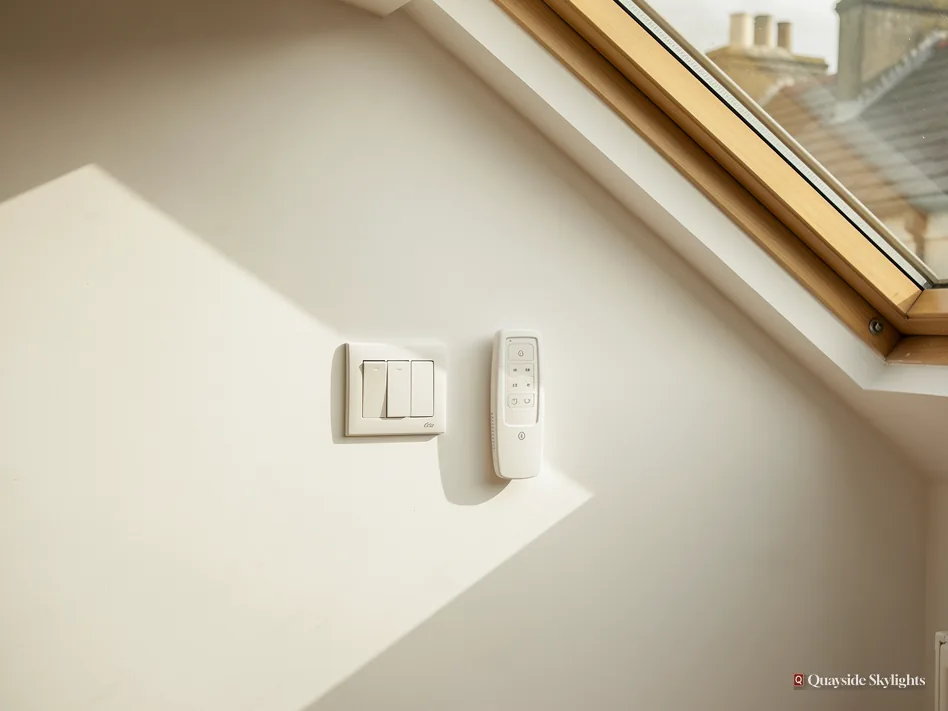
A bright room that turns out cold
Anyone with a bright room that still feels chilly knows the problem. A rooflight swaps a stretch of insulated roof for glass, and the glass has to justify the swap. Pick well and the room is warm, dry and bright. Pick badly and you have a cold patch of ceiling where steam gathers.
What we fit in Willington roofs
We pick each one to suit its roof and to keep the room warm. Roof lanterns, Flat roof rooflights, Roof windows, VELUX windows, Electric rooflights, Energy efficient rooflights, Misted rooflight replacement, Walk-on rooflights, Conservation rooflights, Sun tunnels.
Willington roofs
A warmer way to bring daylight into a Willington house
The four questions below follow a Willington rooflight job from the outside in: which roof you have, what to put in it, how the survey weighs warmth and condensation, and what happens at the end, including sign-off and your guarantee.
What does the roof over my Willington room look like, and why does that come first?
Short answer
Pitched slate or tile roofs and flat extension roofs take different products and different flashings. Until we know which you have, and how it is built, we cannot say what will fit or how warm it will be.
Daylight is the goal, but the roof is the starting point. Willington stands in the foothills of the Pennines, close to the River Wear and to Crook, Bishop Auckland and Durham, and its roofs are what you would expect from a place with a mining past: a mix, built at different times by different hands. We do not guess which yours is.
Pitched roofs
On a slope of slate or tile, the structure under the covering is a set of timber rafters with insulation between or above them. A roof window sits in that structure. The width you can use depends on the gap between rafters, and the flashing depends on the covering. A loft that is warm and lived in is a different case from a cold loft kept for storage, and the choice of product follows.
Flat roofs
A flat roof on an extension is built up in layers: a deck, insulation, a waterproof covering and an upstand at any opening. Over a kitchen or family room it floods the whole floor area with even light. The upstand height, the thickness of the insulation and the age of the roof all have a say in which unit suits.
Why warmth enters at this point
The roof is your main insulating layer. Anything we set into it must be as well insulated as the regulations ask, because the glass will be the coolest surface in the room. So even at the first look, we are asking not only whether a unit fits but how it will behave in the winter.
House or flat
If your home is a house, most rooflights sit within permitted development, within set limits, and the planning guide explains them. For a flat, the planning permission has to come from Durham County Council, and a second owner could have a voice in the matter.
Our view: a rooflight should be chosen for how it holds heat in January as carefully as for how it looks in June.
Which rooflight keeps a Willington room bright without letting the heat out?
Short answer
A well-glazed roof window where the roof is pitched, a flat rooflight with a thermally broken frame on an extension, or a sun tunnel for a small inner room. All of them must meet the limits for existing homes in Part L.
Any rooflight can bring in daylight. Fewer do it while holding warmth in, and that is where the specification matters.
Roof windows
A pitched roof takes a roof window that is glazed to a high standard. For an existing home the Part L limit for a roof window is a U-value of 1.4 W/m²K, or Window Energy Rating Band B. Sealed double units, a low-emissivity coating on one pane and gas between the two, can reach it, and triple glazing goes further. VELUX is a well-known make, though not the only one, and its codes are easy to read. Take MK04: the letter pair is the width and the digit pair is the height, which saves a lot of head-scratching over catalogues. See our roof windows page.
Extension roofs and thermally broken frames
The limiting U-value for a rooflight in an existing dwelling is 2.2 W/m²K. A flat rooflight reaches it with sealed glazing in a frame that is broken thermally, so cold is not carried straight through the metal. A lantern has more glass and more edges, which makes the specification more critical.
Sun tunnels
A sun tunnel has a small footprint in the roof, so little heat escapes. The diffuser at the bottom adds an extra layer between the room and the tube. It suits landings and bathrooms and, because of its small area, is the gentlest of the four on the warmth of a room. The sun tunnels range has its own page.
Blinds, shade and the sun
Heat can arrive as well as leave. A south-facing roof window can warm a loft bedroom on a bright afternoon, and the same window loses warmth after dark. A blind fitted to the window handles both: a reflective one cuts the heat gain in the day, and an insulating one holds warmth back at night. It is worth deciding on the blind with the window, not afterwards, so the fixings are planned and the colour suits the room.
Efficiency is a family of choices
Glass type, frame, seals and the way the unit is flashed into the roof all play a part. Our energy efficient rooflights page goes through them. Tell us which room, and we will point you to the combination for it.
How does a survey of a Willington roof deal with U-values and condensation?
Short answer
We look at the roof build-up, the room's use and the likely moisture, then specify glazing that meets Part L for existing homes. Better glass, a warm frame and good ventilation all reduce condensation.
A survey is the moment to put warmth on the table. It costs you nothing, and it comes before any price.
What the numbers mean
A U-value says how quickly heat passes through a material. The lower it is, the better the product holds heat. For a rooflight in an existing home the limit is 2.2 W/m²K, and for a roof window it is 1.4 W/m²K, or Window Energy Rating Band B. Those are limits, not targets, so when we can, we specify a unit that does a little better.
Why condensation appears
Warm air holds moisture. Meet a chilled surface and some of it falls out as water. Glass is among the coolest surfaces a room has, so droplets form there first, especially in places where people breathe, cook and wash. Better glazing and a frame that does not carry cold across keep the inner surface warmer, and warmer surfaces collect less.
What we look at
At survey we note what the room is used for, whether an extractor is fitted, how much air can move, and how the roof around the opening is insulated. All of this goes into the specification for your quote.
When there is already a rooflight
If your house has an older unit, we read its age and type at survey. Earlier units were made to earlier standards and may be single glazed or lightly sealed. A replacement into the same opening can bring the room up to the current Part L limits, which improves comfort and reduces the damp that gathers on cold glass. The opening and the flashing around it tell us how simple that swap will be.
Ventilation counts
An opening sash lets damp air out, and in a bathroom or kitchen it counts for a lot alongside the glass. A room with a window that opens is easier to keep dry than one with a fixed pane and nothing else. The same reasoning applies in nearby Crook.
| Product | Limiting U-value | Alternative measure |
|---|---|---|
| Rooflight | 2.2 W/m²K | None |
| Roof window | 1.4 W/m²K | Window Energy Rating Band B |
What happens once the Willington rooflight is fitted: sign-off and guarantee?
Short answer
Where the work is notifiable, Building Control is notified and the sign-off follows. You are handed a written guarantee on the workmanship, good for 10 years, along with the manufacturer's details for the unit.
The last glass in place is not the end of a good job. Three things follow, and they are the ones people keep for years.
Building Control
Cutting a new opening in a roof is building work, and it is notified to Building Control, either at the local authority or through a registered building control approver. Whenever the work is notifiable that step is ours, and the sign-off confirms the work meets the regulations, including the thermal limits above.
The guarantee
Ten years of guarantee cover our workmanship, and the wording is written out in full. It covers our work on the unit: the flashing, the seal around the opening and the finish inside. Keep it with the papers for the house. A buyer or a solicitor may ask for it one day, and it is easier to find if it has a settled home.
Using the window well
Give the new window a week or two and its habits become clear.
We show you how the sash and any blind work. In a bedroom, a blind made for the window keeps the room dark. In a kitchen or bathroom, opening the sash after cooking or bathing clears damp air. A little condensation on a cold morning can simply be wiped away.
Keeping the room dry in daily use
A rooflight works best with a few ordinary habits. Run an extractor while cooking or showering if there is one, and open the sash for a few minutes afterwards. Do not dry washing in a room with a fixed pane. Keep the blind slightly clear of the glass so air can circulate behind it. None of this is demanding, and it protects the frame as well as the room.
Deciding about more
Some owners come back after a few months to light a second room. The first survey already holds what we need, and a second quote can build on it. Costs depend on size, access and the roof, which our costs page explains. When you want a visit, ask for one and we will arrange it.
Willington warmth and rooflight queries
Does a skylight make a Willington house colder?
A badly chosen one can, because untreated glass sheds warmth far quicker than a well-insulated roof. A rooflight meeting the Part L limits for existing homes, with good glazing and a thermally broken frame, keeps the loss low. We specify to those limits at survey.
Why does my rooflight run with water in the morning?
Warm moist air has met cold glass. It shows up most in bathrooms, kitchens and bedrooms. A better-glazed unit, a warmer frame and an opening sash all help. We look at how the room is used before recommending a unit.
Can I fit a rooflight in my Willington flat?
A flat has no householder permitted development, so a new rooflight needs planning permission from Durham County Council. Your lease or title shows who is answerable for the roof, and if anyone else must be asked first. Both come before an order.
Is triple glazing worth it in a roof window?
It lowers heat loss further and can quieten rain noise, though the units are heavier and cost more. Whether it suits your roof depends on the frame and the room. We talk through the choice at survey, and the written quote shows what you chose.
Should someone be in when you survey my Willington roof?
It is useful if someone can show us the room and the hatch and what you want from the space. We go through the roof and loft, then send the quote, with its fixed price, in writing.