Guide
Aluminium, timber or uPVC roof lantern frames: choosing the one that fits
The frame is the part of a lantern you see against the sky every day. This guide compares the three common materials by what they do to light, warmth and the look of the room, and where each one sits well.
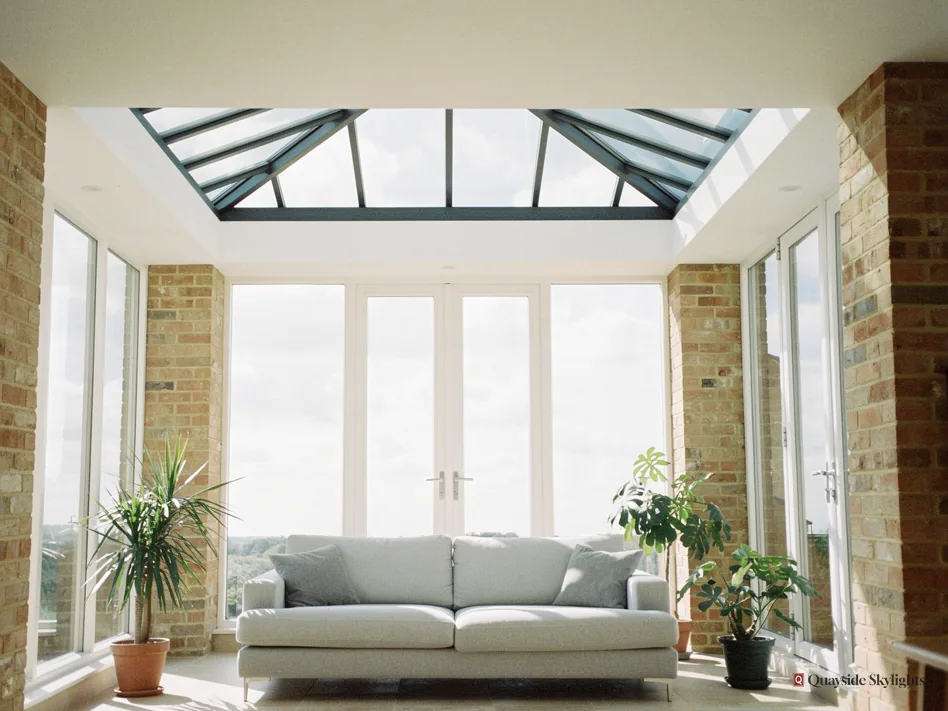
What does a lantern frame actually have to do?
The frame carries the glass, keeps rain out at every joint, holds the heat in and sets how much of the sky is blocked by bars. The material decides how well it does each job.
A lantern is mostly glass, so it is easy to treat the frame as an afterthought. It is not. Every bar is a structural member that holds sloping panes against wind, snow and its own weight. It is also the drainage path for rain and for the moisture that forms inside, and it is the cold edge that glass meets.
Four demands on one set of bars
Strength comes first. The bars span from the kerb to the ridge, and a long span needs a deeper or stiffer section. Weathering comes next: the joints between bars and panes have to shed water for decades. Then warmth, because a bar that conducts heat freely becomes a cold line that can pull moisture out of the room air. Last is appearance, which covers how thick the bars look from below, what colour they are, and whether the inside face suits your ceiling.
No material wins on all four. Each one trades something for something else, and the right trade depends on the room, the budget and how you feel about maintenance.
Why the roof matters too
The kerb under the frame is built on the flat roof of your extension, usually a rear offshoot or kitchen extension. If that structure has limited capacity, a lighter frame may be the sensible choice before looks even come into it. We look at the roof at the free survey, so the frame discussion starts from what the structure will bear rather than from a sample board.
Aluminium: slim bars and a long-lasting finish
Aluminium is strong enough for slim bars, takes a baked-on powder finish in a wide colour range and suits modern kitchen extensions. The frame needs a thermal break to stay warm.
Aluminium is the material that lets a lantern look almost all glass. Because the metal is strong for its weight, the bars can be narrow and still span a wide opening. From inside, that means a lot of sky and very little frame.
The thermal break
Bare metal conducts heat quickly, so a decent aluminium frame is built in two parts, an inner and an outer section, joined by a strip of low-conductivity material. That strip is the thermal break. Without it the inner face of the bars runs cold in winter and collects condensation. When you compare quotes, ask each supplier whether the frame is thermally broken and how the glazing sits in it.
Colour and finish
Aluminium is usually powder coated, a dry paint baked onto the metal. The finish can differ inside and outside, so a lantern can be dark grey against the sky and white against a kitchen ceiling. That two-tone option matters in a room where the ceiling is a bright colour and you do not want black lines crossing it.
Where it sits well
Aluminium suits a flat-roofed rear extension on a modern or renovated house, and it suits a Tyneside flat's back kitchen where the aim is to bring in as much daylight as the roof allows. It is less natural beside a period brick elevation if you want the frame to blend into old materials, and that is where timber enters the discussion.
One practical note about the neighbouring surfaces. Metal frames are cooler to touch than timber, and a lantern with a big aluminium section can feel stark in a small snug. In a large open kitchen the same frame disappears.
Timber: warmth, character and a finish that needs looking after
Timber is naturally a poor conductor, looks right beside older brick and can be painted any shade. Its bars are chunkier than aluminium and the paint or stain needs renewing over time.
Timber is the oldest lantern material and still the one that sits most comfortably with traditional buildings. Wood does not conduct heat the way metal does, so the inside face of a timber bar stays close to room temperature. Condensation along the frame is less of a worry than with a poorly detailed metal one.
Sightlines and span
The trade is bulk. A timber section needs more depth and width than aluminium to span the same distance, so a timber lantern shows more frame against the sky. For a modest lantern over a dining area, that can be exactly the look wanted. For a very large lantern, the bars may become too heavy to feel elegant, and the extra weight reaches the roof structure.
Looking after the finish
Timber is protected by paint or stain, and that coating does not last forever. A factory-applied finish gives a good start, but the outer face sees sun, rain and frost and will want attention over the years. Think of it as a small recurring job, in the way a timber front door asks for one. If you would rather never think about it again, aluminium or a clad option is the better fit.
Aluminium-clad timber
There is a middle route. Some makers face the outside of a timber frame with aluminium, so the weather sees metal while the room sees wood. It costs more to make and the section is deeper, but it answers the upkeep concern and keeps the warm inside look. It is worth raising if you want a timber interior with a low-attention exterior.
Where it sits well
Timber fits Victorian and Edwardian houses in Jesmond, Gosforth and Heaton where a rear extension meets old brick, and it is the natural choice where listed building consent makes the look of the frame part of the decision.
uPVC: a practical frame with limits on size and shape
uPVC frames are warm, need only occasional washing and suit modest lanterns. Their bars are bulky, the colour choice is narrower and larger spans need steel inside.
uPVC is a plastic section extruded in chambers, and those air chambers give it good insulating behaviour. The material does not need painting, and a wipe with a mild cleaner keeps the surface presentable. For a modest lantern over a small extension, it is a sensible, plainly practical frame.
The strength question
Plastic on its own is not stiff enough to span far, so longer bars are reinforced with steel or aluminium inside the section. You cannot see that core, but it adds weight and it adds width. The result is that uPVC lanterns show broader bars than aluminium ones, and the roof must carry more frame for a given opening. There is a ceiling on how large and how complex a uPVC lantern can sensibly be.
Colour and age
White is the simple choice. Foiled finishes in grey, black or woodgrain exist, and they widen the palette, though the choice is narrower than a powder-coated metal range. Ask to see a sample in daylight. Some tones look different against a sky than on a showroom card, and a frame that reads as plastic from the garden may bother you every time you look up.
Where it sits well
uPVC suits an ordinary house extension where the neighbouring windows are already uPVC and the lantern should match them. It suits a lantern of simple outline, such as a plain ridge shape, and an owner who wants minimal looking after. It is not the material to choose if you want the thinnest possible bars or a very large, multi-faced design.
If you are weighing it against aluminium, the useful comparison is bar width and colour range, not warmth, because both can be specified to a good thermal standard.
| Material | What you see | What it asks of you |
|---|---|---|
| Aluminium | Narrow bars, wide colour range, two-tone possible | Little beyond washing; thermal break must be specified |
| Timber | Deeper bars, warm interior, painted or stained any shade | Periodic repainting or restaining of the outer face |
| uPVC | Broader bars, limited colours, plain outline | Occasional washing; size and shape limits |
| Clad timber | Wood inside, metal outside, deeper section | Little outside; higher cost to make |
Which material suits which house on Tyneside?
Start from the house. Period brick and a conservation setting point to timber or slim metal; a modern rear extension suits aluminium; an everyday semi with uPVC windows can carry a uPVC lantern.
The house is the first question, because the frame has to live beside what is already there. A lantern that suits a new-build kitchen can look wrong on a Victorian offshoot, and the other way round.
Victorian and Edwardian terraces
On a terrace in Heaton, Jesmond or Gosforth, the rear extension often meets brick of its own age. Timber, or a slim aluminium frame in a dark, matt colour, tends to settle into that setting. A glossy white plastic frame can feel at odds with it. If the house is in a conservation area, the rules on rooflights on a house are not changed by that fact alone, but you may want the frame to suit the setting anyway, and for a listed house the choice of material is likely to be part of the listed building consent.
Tyneside flats
A downstairs Tyneside flat often has a rear yard or a flat-roofed kitchen offshoot. A lantern there is a planning matter, since a flat has no householder permitted development. The material is secondary to getting that permission, and our page on lantern planning rules sets out the route. Once permission is in hand, frame choice follows the same logic as for any house, with extra weight on lightness because shared roof structures can be sensitive.
Semis and estate houses
Inter-war semis in Kenton and Walkergate, and the later estates around Killingworth and Cramlington, often have uPVC windows already. A uPVC lantern on a simple rear extension keeps the look consistent, while aluminium gives a sharper contrast if the extension is a deliberate modern addition.
New builds
On new-build streets like Newcastle Great Park, an extension is usually clean and square-edged. Aluminium tends to match that crispness, though anything that picks up the window frames will look coherent.
How the glazing and the frame work together
The frame sets how the panes are held, sealed and drained. A fine frame with weak glazing, or the reverse, wastes the effort, so decide them as one package.
Choosing the frame in isolation is a mistake. The glass and the bars are one assembly, and the weakest link sets the result.
Where the panes sit
Panes are held by pressure plates and gaskets or by bonded joints, depending on the system. The way water drains out of the bar channels, and whether there is a ventilated cavity, affects how long the seals last. A good system has an escape route for moisture rather than relying on a perfect seal alone.
Matching the glass to the frame
A lantern over a room is normally glazed with a laminated inner pane, which holds together if it cracks. Add a solar control coating and the lantern can run cooler in summer, while a low-emissivity coating helps in winter. These choices apply to every material, but a very deep triple-glazed unit needs a frame section deep enough to hold it, which pushes aluminium bars deeper and timber bars much deeper. Our guide to double and triple glazing goes through what each gives you.
Inside the room
Look at the inner face of the bars. A square profile, a chamfer and a flat internal reveal each catch light differently. Photograph your ceiling in daylight and compare it with the sample, because bright white and pale grey can look different against each other than you expect.
The frame also needs a clear route into the room: the lantern's lining, kerb finish and ceiling reveal must be decided with it. The sizing guide, how big a lantern should be, covers that side of the work.
Questions to put to any lantern supplier
- Is the frame thermally broken, and how is the glazing held and drained?
- What is the bar depth and width at the span my room needs?
- Is the finish the same inside and out, or can the two faces differ?
- What will the outer face ask of me in upkeep, and how often?
- What does the whole assembly weigh against my roof structure?
Making the final choice without a showroom
Decide in this order: what the roof can carry, what the house looks like, how much upkeep you accept, then colour. We talk it through at the free survey and quote a fixed price afterwards.
There is no public showroom to wander through, and there does not need to be. The decision is easier made at the house, with the roof in view.
A simple order of decisions
First, what can the roof carry? That sets the weight and therefore the realistic material range. Second, what is the house like around the lantern? Brick age, neighbouring window frames and the colour of the ceiling all steer the answer. Third, how much looking after are you happy with? If the answer is none, rule out bare timber. Fourth, colour and finish, which are the most reversible choices and the last to settle.
What the survey adds
On the survey visit we look at the roof, measure the opening and talk through frame options in the context of your actual extension. After that a fixed written quote follows in writing, and its figure holds unless the work itself changes. The cutting of a new opening is building work, so we handle the Building Control notification, which goes to the local authority or a registered building control approver.
Planning comes first for flats
If you live in a flat, settle the permission question before you fall for a frame. A new lantern on a flat needs planning permission, and the title or lease of your flat should be read, and the other owner spoken to, before any order is placed. Our roof lantern service page explains how a job runs from enquiry to finish.
Once those basics are fixed, the material becomes a pleasant choice rather than a worrying one, and you can start with a free survey through the quote form.
Our view: pick the frame the roof can carry and the house can live beside, then let colour follow.
Frame material doubts, settled
Can a lantern frame be a different colour inside and out?
Yes, in most aluminium systems, because the finish is applied to each section separately. Timber can be painted any shade on either face. A uPVC frame is more limited, and a two-tone finish takes a foiled or co-extruded option.
Does a thermally broken aluminium frame feel cold in winter?
The inner face stays much closer to room temperature than bare metal would, because the break stops heat flowing straight through. The glass is still the coldest part of any lantern, so very cold mornings can show some mist on the panes.
Will timber lantern bars warp or rot?
Properly made and finished timber, kept coated, stays stable for a long time. Trouble starts when the paint film is allowed to fail and water reaches bare wood. A clad timber frame removes that exposure on the outside.
Is a uPVC lantern allowed where an aluminium one would be?
The planning rules look at height and position, not the material, so on a house the 150mm projection limit applies equally. A listed building or a flat is different, and our planning answer explains why.
Does the frame material change the price?
It can, along with size, glazing and how awkward the roof is. We publish no figures. What moves a price is set out, without numbers, on our costs page.