Guide
Why rooflights mist up between the panes
A rooflight that clouds from the inside of the glass has not got dirty. Something has gone wrong with the sealed unit. This guide explains what, why it happens to some skylights sooner than others, and what the choices are.
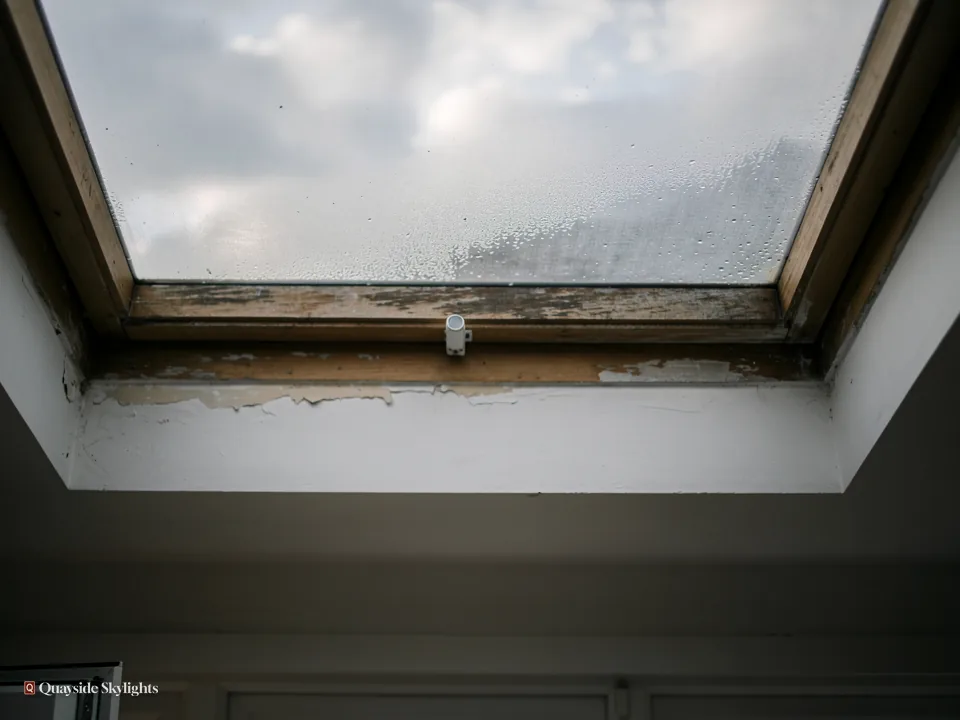
Which kind of mist have you got?
Moisture can sit on the room face, on the weather face or trapped between the panes. Only the third is a failed sealed unit, and only the third cannot be wiped away.
People say a rooflight has misted when they mean any of three different things, and each has a different cause. Working out which one you are looking at saves a lot of worry, and it can save you from replacing glass that is perfectly sound.
On the room side
Glass is the coldest surface in a room, so warm, damp air touches it and turns to water. A kitchen with a boiling pan, a bathroom after a shower or a bedroom with the door shut all do this. The film wipes off with a cloth. It tells you about the room's ventilation, not about the rooflight, although a poorly insulated old unit is colder and so collects more of it.
On the weather side
On a clear, still night the outer pane can lose so much heat to the sky that dew forms on the outside. That is a sign the glazing is insulating well, because the inner pane is keeping the heat in the house. It burns off once the sun reaches the roof.
Between the panes
If the haze, droplets or water lines sit inside the unit, where no cloth can reach, the sealed unit has failed. Damp air has found its way into the gap, and it comes and goes with the weather, thickest on cold mornings and fading by afternoon. That is the mist this guide is about.
| Where it sits | How it behaves | What it points to |
|---|---|---|
| Room face of the inner pane | Wipes clean, returns after cooking or showers | Room humidity and ventilation |
| Weather face of the outer pane | Clears as the sun warms the roof | Glazing that is holding its heat in |
| Inside the sealed gap | Cannot be wiped, comes and goes with the weather | A sealed unit that has let air in |
How does a sealed unit let moisture in?
Two panes are held apart by a spacer bar and glued round the edge. When that edge seal ages, air enters, the drying agent in the spacer fills up and the gap starts to fog.
A modern rooflight pane is really a sandwich. Two sheets of glass sit either side of a hollow metal or composite spacer bar, and the join is closed by a seal running all the way round the edge. The space between is filled with dry air or an insulating gas, and the spacer is packed with a drying agent that soaks up any trace of moisture left from manufacture.
The seal is the weak point
Everything depends on that edge seal. Over the years it expands and contracts with the heat of the day and the cold of the night. Tiny gaps open, and water vapour, which is small enough to creep through gaps liquid water would never find, starts to enter. For a long time the drying agent takes it up, and nothing shows. Once it is full, there is nowhere left for the vapour to go, and the first fog appears at the edges of the glass.
How the fog grows
After that, each cold night turns more vapour into droplets on the inside faces. The mist often begins as a ring around the rim and works inward, or collects at the lowest corner of a sloping pane where water drains. Limescale-like marks can be left behind when the water dries, and these do not clean off because they are on the inner faces.
What it does not mean
A failed seal says the unit has aged. It does not say the glass is about to break, and it does not say the frame has failed. Those are separate questions, taken up in our answer on the safety of a fogged unit.
Why do some skylights fail sooner than others?
Standing water at the edge, strong sun, big temperature swings and low-grade seals all shorten a unit's life. Position on the roof and the build of the frame decide how hard the seal works.
Two rooflights put in together can fail years apart. The seal is a manufactured part, and how long it lasts depends on how it is built and on what the roof does to it every day.
Water that sits on the edge
A seal that is kept wet is under siege. On a flat roof, the glass edge can sit in a puddle or a film of damp debris, especially where the frame does not drain well. The same goes for a roof window with a blocked weep channel. Persistent water at the edge works on the sealant far more than the occasional shower.
Sun and temperature swing
A south-facing pane in summer can run very hot, then drop sharply at dusk. Dark frames soak up sunlight and pass that heat straight to the glass edge. Every cycle flexes the seal a little. Rooflights with shading or a lighter frame ask less of it.
Build quality and age
Seals vary in the sealant used, in how deep they are and in how well the spacer is bonded. Cheaper units, and older ones made before better edge systems arrived, tend to give up sooner than well-made modern ones. A unit that has misted after a short time is worth mentioning to whoever supplied it, because the guarantee on the glass is a separate matter from any workmanship guarantee.
Plastic domes are different
A twin-skin dome is not a glass sandwich. It can still collect damp between its skins, but the cause and the options are different, and our answer on swapping a plastic dome for glass picks that up.
Clues that point to the cause
- Mist that starts at one low corner often means water sits at that edge
- A pane that clouds on one slope and not the other suggests heat from the sun
- Fog in a unit only a few years old is worth raising with the supplier
- A dark frame on a south slope puts extra heat into the glass edge
- Staining on the outer frame can show drainage that has stopped working
Can misting be stopped or cleared?
Not in any way that lasts. Once air has got into the gap, the unit cannot be resealed to the standard it was made to. The choices are a new unit in the frame or a whole new rooflight.
It is tempting to look for a quick answer. Some people try drilling a small hole to let the moisture out, or dropping in drying crystals. Neither deals with the cause, which is a seal that no longer keeps air out. The vapour returns the next time the weather turns.
What the unit has lost
Fog is the visible symptom, but the glazing is also doing its job less well. Once the gap holds damp air in place of dry air or gas, the unit insulates worse than it did, and the room feels it, with a colder pane and more condensation on the room face. That is a practical reason to deal with a misted unit, even when the view out is only slightly spoilt.
The two ways forward
The first is a new sealed unit set into the existing frame. It suits a frame that is square, sound and well drained, and it leaves the opening as it is. The second is a whole new rooflight, which replaces frame and glass together. The frame, the age of the installation and the rating of the new product settle which suits you, and our guide to replacing the glass or the whole unit sets out the comparison.
Not urgent, not forever
A misted pane is rarely an emergency, so a survey, a quote and a considered choice can all take their natural course. But the mist will not clear itself, and a unit left alone keeps losing performance. The overall picture of what we replace and how is on our misted rooflight replacement page.
Does the type of home change what you do next?
The glass is the same either way, but the paperwork is not. Flat owners face a different planning route from house owners, and may share the roof. Check your title or lease before ordering.
The mist looks identical in a semi in Kenton and an upstairs flat in Heaton. What differs is whose agreement the work needs and which rules apply.
On a house
A rooflight on a house is permitted development under Class C if it projects no more than 150mm beyond the plane of the roof slope and sits no higher than the highest part of the roof. A like-for-like replacement is unlikely to alter that, though a taller upstand or a different product could, so the finished height is worth knowing before you order. An Article 4 direction, or a condition on an earlier planning permission, can remove Class C from a house.
On a Tyneside flat
Flats and maisonettes have no householder permitted development, so a new rooflight on one needs planning permission from the council. A replacement is a different question from a new one, and your council can say how it treats a like-for-like swap at your address. The roof also raises a separate point. On a shared roof, the lease or title decides whose consent is needed; have that to hand and tell the other flat's owner first.
Conservation areas and listing
A conservation area on its own does not remove Class C for a rooflight on a house. A listed house keeps Class C on the planning side, but almost any rooflight on it needs listed building consent, and that consent decides the job. Historic England and your council publish guidance on both.
Building Regulations
Cutting a new opening in a roof is building work and is notified to Building Control, the local authority or a registered building control approver. Under Part L, for an existing dwelling in England, the limiting U-value is 2.2 W/m²K for a rooflight and 1.4 W/m²K for a roof window. Where a job is notifiable, the notice to Building Control comes from us.
What does a sensible next step look like?
Photograph the mist, find out what you have, then book a free survey. We price after seeing the frame and roof, and the written quote stays fixed unless the job changes.
You do not need a diagnosis before you get in touch. What helps is a little information that costs nothing to gather.
Before the survey
Take a photo of the pane on a cold morning, when the mist is at its worst, and another of the whole rooflight from inside. Note roughly when it was fitted, if you know, and whether it is glass or a plastic dome. Anyone in a flat should read the roof wording in their lease or title.
At the survey
On the roof we study the frame, whatever it stands on, where rain runs off and how the seals have aged. That is what decides between a new unit and a new rooflight. We also read the house itself: its type, its ownership and which rules apply. You pay nothing for the survey, and a price follows only afterwards.
After it
A written quote follows, fixed from then on unless the job itself alters. Where the work is notifiable, we deal with Building Control, and the installation carries our 10-year workmanship guarantee in writing, which you can read on our guarantee page.
Booking
The quote form is the quickest route, or you can message us on WhatsApp 07880 284133. Say what the rooflight is, where it is and what the mist looks like, and we will take it from there.
Misting puzzles, answered
Is it condensation or a failed unit?
Wipe the glass. If the film comes off, it was condensation on a face of the pane. If the haze sits inside, where you cannot reach, the sealed unit has failed. Checking at different times of day helps, because failed units clear and cloud again with the weather.
Will a misted rooflight leak?
Not because of the mist. The seal that has failed is the one between the panes, not the weatherproofing between the frame and the roof. Water coming in is a separate fault, and the survey looks at both the glass and the way the frame meets the roof.
Does a misted pane make the room colder?
It can. Moist air between the panes passes heat across faster than the dry filling did, so the inner pane runs colder and the room can show more condensation. The effect is gradual, which is why it is easy to put up with for too long.
Can I just wait until it gets worse?
You can, because mist is not usually urgent. But the unit will not recover, and a cloudy pane steadily spoils the daylight you fitted it for. Getting a survey and quote now lets you plan the work for when it suits you.
Does it matter that my rooflight is on a flat roof?
It can affect why the unit failed, because water sitting round a flat rooflight's edge shortens a seal's life. It also affects the fix, since the upstand and roof covering are part of the job. Our flat roof rooflights page covers how those are built.