Guide
Glass only or the lot: choosing what to replace in a rooflight
Once a unit has fogged, there are two ways to put things right. You can replace rooflight glass and keep the frame, or take out the lot. This guide sets out what points each way, in the order we weigh it up on a roof.
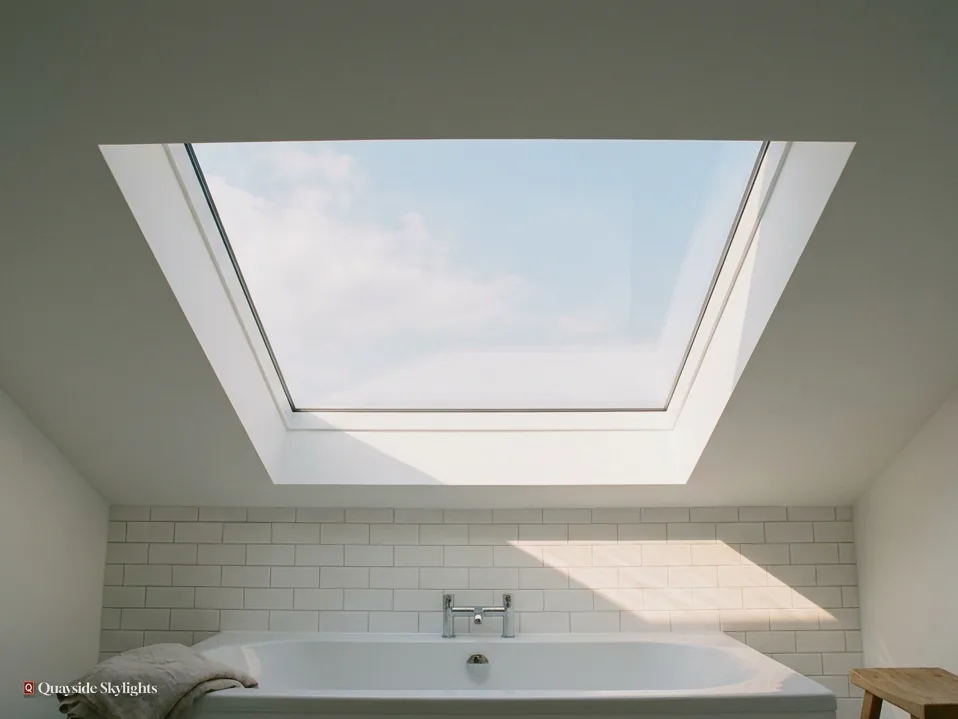
What does replacing just the glass involve?
The old sealed unit is lifted out of the frame and a new one made to its measurements is set in. The frame, the upstand and the roof covering stay where they are.
A glass-only job treats the frame as a housing and the sealed unit as the part that has worn out. Because nothing else is disturbed, the opening, the kerb and the weatherproofing round the edge stay untouched, and the work is confined to the glazing.
How the new unit is made
The unit is not bought off a shelf. We measure the existing one, or its rebate in the frame, and the glass is made to that size. Thickness matters as well as width and length, because the frame has a fixed groove and the new unit must sit in it with the right clearance all round. The build of the glass follows where it sits. Glass is specified by position: laminated on the inside face over living space, toughened outside on a flat roof.
Setting it in
The beads or capping that held the old unit are removed, the unit comes out, the rebate is cleaned and the new unit is bedded on fresh seals and held in place. On a roof window with a clip-in glazing, the process is quicker still. On a bonded unit, it asks more care.
What it does not do
It does not change the size of the rooflight, its colour or the way it opens. It does not add a new opening, so there is no new hole to cut. And it cannot improve a frame that is tired, which is where the next question comes in.
When does the frame rule out keeping it?
A frame that is out of square, soft, corroded or badly drained cannot carry new glass for long. If it is sound, a new unit is practical. If not, the whole rooflight goes.
A new sealed unit starts a new clock for the glass only. If the frame round it is near the end of its own life, you will be paying for the same disturbance twice. That is why the survey looks at the frame before it looks at the price.
Timber, aluminium and plastic
A timber frame can be soft at the corners, and soft wood will not hold a new seal. An aluminium frame is generally sturdier but its gaskets perish, and the thermal break, where there is one, can be tired. A plastic frame may have bowed in the sun. Any of these may be fine, or may not, and the answer comes from looking and pressing, not from the material alone.
Drainage and the water path
The reason many seals fail early is standing water at the edge. A new unit in a frame whose weep paths are blocked or that does not shed water will mist again for the same reason. So we look at how water reaches the gutter or the roof outlet, and where the frame meets the covering, before agreeing that glass alone will do.
Fixings and the upstand
On a flat roof, the frame is fixed to an upstand. If that upstand is damp, crumbling or too low, a new unit on top inherits the problem. Manufacturers set minimum upstand heights, commonly around 150mm above the finished roof, and an old kerb may fall short. The same goes for the flashings on a pitched roof. If these have to be rebuilt anyway, replacing the whole rooflight costs little more than doing the glass and then the surround.
What we look at before choosing
- Whether the frame is square and the corners are firm
- How rain leaves the frame and the roof around it
- The height and condition of the upstand or flashings
- Whether the opening mechanism, if any, still works smoothly
- How easily the old unit can be lifted out without damage
How do the two options compare on warmth and rules?
A new sealed unit in an older frame relies on the frame round it. A whole new rooflight is rated as a complete product, against the Part L limits for rooflights and roof windows.
Heat loss is the part of the choice that does not show on the day but shows every winter.
A unit in an old frame
Fresh glass restores what the glass can do. It cannot restore what the frame never did. An older frame without a thermal break lets heat run straight round the new unit, and the cold edge can still gather condensation. The gain is real, but it has a ceiling set by the frame.
A complete product
A new rooflight or roof window is rated as a whole, frame and glass together. Under Part L, for an existing dwelling in England, the limiting U-value is 2.2 W/m²K for a rooflight and 1.4 W/m²K for a roof window, or WER Band B. A product chosen to meet those figures has a known standard from the first day. That is a firm basis for a quote, and it is the reason a whole new unit is often the tidier answer on an older installation.
Building Control
Cutting a new opening in a roof is building work and is notified to Building Control, the local authority or a registered building control approver. Changing a unit in the opening that is already there cuts no new opening. Whether your job is notifiable is settled at the survey, and if it is, we send the notification ourselves.
| Point | New glass in old frame | Whole new rooflight |
|---|---|---|
| What changes | Only the sealed unit | Frame, glass and usually the seals |
| Frame condition | Must already be sound | No longer a limit |
| Thermal result | Capped by the old frame | Rated as one product |
| Opening and upstand | Left as found | Can be reset or rebuilt if needed |
| Lead time | Glass made to measure | Depends on the product chosen |
Is sizing a unit for an old frame harder than it sounds?
Yes. The glass must fit an existing rebate to a close tolerance, and an older or discontinued frame can be harder to match than a modern one. Accurate measuring prevents a wasted order.
Ordering a new rooflight is a matter of choosing a size from a range. Ordering glass for an old frame is closer to tailoring, and it can go wrong when the measurements are loose.
Getting the numbers right
The width and length of the pane, its thickness, the depth of the rebate and the clearance all have to be right, and they are measured on site at the survey. Frames are rarely perfectly square, so two corners may need to be checked against each other and the unit made to suit the worst case. An error of a few millimetres can be the difference between a unit that drops in and one that cannot be seated.
Older and unusual frames
Where a frame belongs to a range that is no longer made, there may be no standard glazing profile to copy, and the unit is made from the measurements alone. Odd shapes, curved tops and small custom frames add to that. If the survey finds the frame hard to match and also past its best, a whole new rooflight is usually the more dependable answer.
The wait for glass
Made-to-measure glass takes time to be manufactured, and the time is set by the maker, not by us. A complete rooflight from a stock range may be available sooner, while a made-to-measure rooflight can take as long as the glass does. When time matters, the comparison goes onto the quote so you can choose knowing what the wait is. The timing answer for an old rooflight swap goes through the stages.
Do planning and ownership change the choice?
Only if the new rooflight is bigger, taller or in a different place. On a Tyneside flat, no householder permitted development applies, and the title or lease may give the other owner a say.
A like-for-like swap rarely raises new planning questions. Whichever option you choose, the questions begin once the new product differs from the old one.
If the product changes
On a house, a rooflight is permitted development under Class C if it projects no more than 150mm beyond the plane of the roof slope and sits no higher than the highest part of the roof. A new rooflight with a deeper frame or a taller upstand than the old one could change that. So the finished height goes into the survey notes. An Article 4 direction, or a condition on an earlier permission, can remove Class C from a house, so your council's planning team is the place to check.
On a Tyneside flat
Flats and maisonettes have no householder permitted development. A new rooflight on either flat of a Tyneside pair goes through the council's planning process. Ask the planning team how it handles swapping one that is already there. Consent to roof work is a legal point found in the papers for each flat. Read yours and involve the other flat's owner early.
Listed and conservation-area homes
A conservation area on its own does not remove Class C for a rooflight on a house. A listed house keeps Class C on the planning side, but almost any rooflight on it needs listed building consent, and that consent decides the job, including whether glass can be replaced in an old frame or the frame itself must stay. See Historic England's guidance and your council's conservation team.
How do we settle on one in practice?
The frame and the surround decide first, then the performance you want and the paperwork. We lay both options out in the written quote so the price and the difference are visible side by side.
There is no rule that says glass-only is cheaper in the long run, or that a new rooflight is always better. What settles it is the roof itself.
Leaning towards glass only
When the frame is sound, drains well and sits on a good upstand or flashing, and the main aim is to clear the mist and restore the unit, fresh glass is a reasonable and direct answer. It also suits a rooflight that is an unusual shape or in a position where changing the frame would disturb a lot round it.
Leaning towards a new rooflight
When the frame is tired, when the upstand needs work, when you want a better thermal standard or when the old product cannot be matched, a new rooflight is the sounder basis. It gives you a rated product, a reset surround and one clean start, where glass only would be a stop-gap.
What you get from us
The survey costs nothing and always precedes a price. A fixed written quote comes next, and the fitting is covered by a 10-year guarantee on our workmanship, put in writing. See the page on replacing misted rooflights for the wider picture, our costs page for what moves a price, and the quote form to arrange a survey.
Our view: if the frame is sound and drains well, new glass is a fair answer; if it is not, replace the whole rooflight.
Before you decide on glass or frame
Can you tell from the photos which option suits?
Photos help to show the type and size, but the frame, the upstand and the drainage are judged in person. That is why the survey comes before any price. It lets the quote name one route, with the other set beside it where it is a close call.
Will new glass match the old frame's colour?
The frame keeps the colour it has, so nothing changes outside. The glass can differ slightly in tint or coating from the old unit, which sometimes shows when the old and new panes of a pair are compared side by side. A whole new rooflight lets you choose the finish.
Is the guarantee the same for both routes?
Either route comes with the same 10-year written workmanship guarantee. The glass or product itself carries the maker's own terms, which we pass on with the quote. Read both, since they cover different things.
Can an electric opening rooflight keep its motor?
Sometimes, if the mechanism is sound and compatible with the new glass weight. The survey tests the opener first. Where the motor is old or tired, replacing the whole unit gives a matched set; see our electric opening rooflights page.
Do I need to be at home for a glass swap?
Someone needs to give access to the rooms below the rooflight and to the roof route. For a flat, that also means any shared access. We settle the arrangements with you when the survey date is booked.