Guide
Sun tunnel or rooflight: which one suits your room?
Both bring daylight through the roof, yet they behave very differently once fitted. They are compared on light, view, air, roof and rules, followed by a simple way to choose.
A pipe of light or a window in the roof
A tunnel pipes daylight to a ceiling panel and offers nothing beyond that. A rooflight is a pane of glass set into the roof, so it lights the room directly and lets you see the sky.
The two products share a roof and little else. Once you picture how each one reaches the room, most of the choice makes itself.
How a sun tunnel works
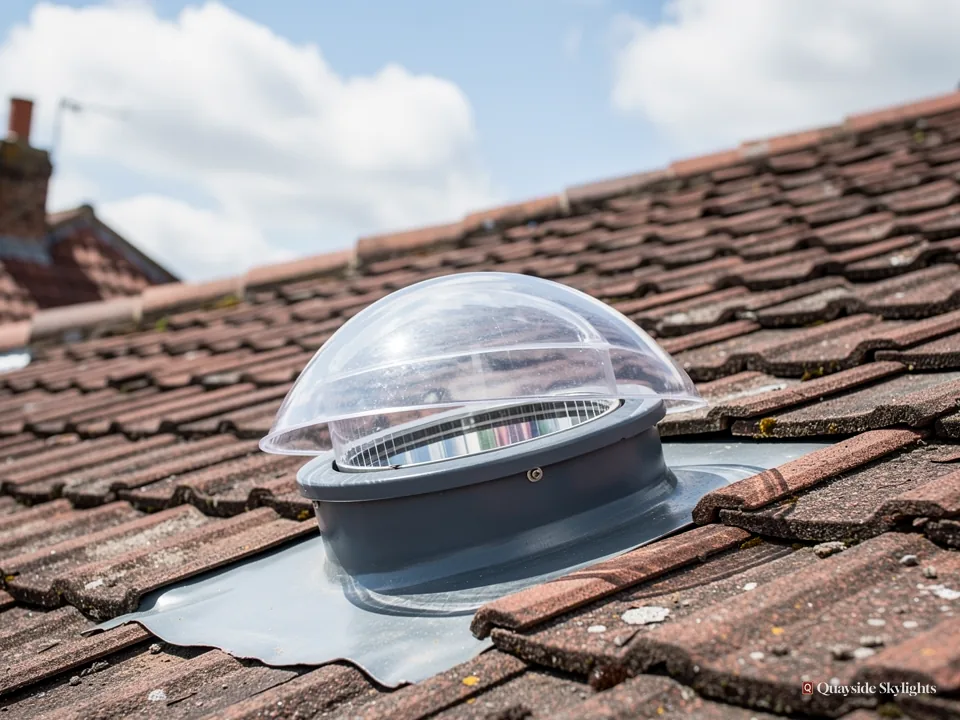
On the outside there is a clear dome on a small base. Beneath that, a tube lined with mirror-finish material drops through the loft space. Inside, a frosted panel in the ceiling fans the light out over the floor. The roof cut is modest, and inside you see only a white disc that could pass for a downlight.
How a rooflight works
A rooflight is glazing in a frame, set straight into the roof. On a pitched roof we usually call it a roof window or a skylight. On a flat roof it might be a flat rooflight or a lantern. The glass is directly above the room, so light arrives without being channelled, and you can look up at clouds, stars or a gull going past.
Where the difference shows
A tunnel is a light fitting that happens to run on daylight. A rooflight is part of the room's architecture. The argument about which is better goes away once you decide whether the space needs a feature or just needs brightening. Our sun tunnels page covers the daylight pipe in detail, and our comparison of rooflight types shows the glazed family side by side.
How much light does each one really give a room?
A rooflight lights a room much more strongly than a tunnel of the same footprint, because glass faces the sky directly. A tunnel is a good match for a small space; a large room needs glazing.
Light is where people expect the biggest gap, and they are right to. A tunnel funnels a small circle of sky through a long tube, and some of what goes in is lost on the way down. A rooflight lets in everything that falls on its glass.
Matching the source to the space
A landing, a cloakroom or a walk-in wardrobe needs a gentle, even glow. A tunnel does that well, and a rooflight there would flood the space and may leave it too bright on summer days. A kitchen-diner, a loft bedroom or a studio needs a good deal more, and a tube is not up to it. Think about what you do in the room. If you read, cook or work there, you want brightness at a surface. If you only pass through, you want a space that does not feel like a cave.
Direction and weather
Sun tunnels do not care much which way the roof faces, since the dome collects light from a wide patch of sky. Rooflights are fussier. A north-facing glazed opening gives even, soft light, and a south-facing one gives more heat and glare. The sky around Tyneside is often overcast, so a tunnel in a dull week will still lift a gloomy landing, though it will not rival a window.
| Point | Sun tunnel | Rooflight |
|---|---|---|
| Strength of light | Gentle and even; suits small rooms | Strong; suits rooms people live in |
| View of the sky | None; light only | Full view through the glass |
| Fresh air | None | Possible with an opening unit |
| Size of roof opening | Small, between rafters | Larger; may need framing work |
| Roof it suits | Pitched or flat, with a clear route | Pitched or flat, over the room |
| Best for | Landings, hallways, windowless bathrooms | Lofts, kitchens, extensions |
Do you want to see out, or let air in?
Only a rooflight gives a view and, if you choose an opening unit, ventilation. A sun tunnel brings light and nothing more, so a bathroom with a tunnel still needs a fan.
A product chosen only for its light can disappoint a year later. Settle early what the opening is for.
The view question
A tunnel hides its source. You see a bright disc in the ceiling and nothing beyond it. That suits a bathroom or a store, where nobody wants to look out. Glass over a bedroom lets you watch the weather turn, a real pleasure in a small loft room.
The air question
A fixed rooflight and a tunnel both stay shut. An opening roof window or a vented flat rooflight can let stale air out and fresh air in, with manual or electric controls. If your plan relies on opening the window to clear steam or warmth, a tunnel will disappoint you. For that you need either an opening unit or a mechanical extract fan, and a bathroom needs a fan whichever light source it has.
Privacy and glare
The tunnel's frosted diffuser keeps the room private, with nothing to overlook. Glass in a rooflight is clear, so a blind may be wanted over a bed, and sunshine can reach the floor at low angles. Both points are easy to plan for when you know the room, and we raise them at the survey. If you are drawn to the glazed route for a loft room, our roof windows page explains what is on offer.
What does the roof above the room have to offer?
A tunnel needs a clear run from roof to ceiling, which a bedroom or a full storey above can block. A rooflight needs the roof to sit directly over the room and be framed to carry the opening.
The roof is where good ideas meet reality. A product that suits a room on paper may have no way of getting there.
The tunnel's route
A tube must travel from the dome to the ceiling in a reasonably straight line, through the loft or between rafters and joists. Any bend costs light, so a short, direct route is best. If another room or a floor sits between the ceiling and the roof, there is no path. That is why tunnels find their place on top-floor landings and bathrooms and in rooms under a flat extension roof. Our answer on how far a tunnel can run deals with length and bends.
The rooflight's frame
A rooflight needs an opening cut in the roof that is bigger than a tunnel's. On a pitched roof that can mean cutting a rafter and fitting trimmers around the gap. On a flat roof it means a kerb and sometimes a deeper structural change. The roof must lie directly above the space you want to light, and the opening has to sit between structural members or be framed around them.
Roof type in Tyneside
Terraces and semis with plain pitched roofs offer easy routes for both products. A back offshoot often has a flat or low-pitched roof of its own, which suits a flat rooflight or a flat-base tunnel. We look at the roof on the free survey and tell you plainly which options it supports. For flat roofs in particular, see our flat roof rooflights page.
Check these before choosing a source of light
- Is there a clear straight route from the ceiling up to the roof?
- Is a sight of the sky wanted, or just a brighter surface?
- Must the opening help ventilate the room?
- Would a soft, even glow be enough for this room?
- Does the roof over the room belong to you alone?
Do the rules treat the two products differently?
Largely the same. Both are roof openings, so a house usually relies on permitted development, a flat needs planning permission, and the opening is notified to Building Control either way.
Planning law does not care whether the light comes down a tube or through a pane. It cares about what stands on the roof and what kind of home it is.
Houses
On a house, a rooflight is permitted development under Class C if it projects no more than 150mm beyond the plane of the roof slope and sits no higher than the highest part of the roof. A sun tunnel dome is checked against the same limit. On a side-elevation slope, the whole window must be obscure-glazed, and non-opening unless the parts that open are more than 1.7 metres above the floor of the room. An Article 4 direction, or a condition on an earlier permission, can remove Class C. A conservation area alone leaves Class C in place.
Flats
A Tyneside flat is a flat, upstairs or down, and flats have no householder permitted development. A new rooflight or tunnel on one needs planning permission from the council. Owning a Tyneside flat does not settle who owns its roof. Check the title or lease, and ask the other owner, before ordering. Legal advice on ownership is outside what we offer.
Building Control
Cutting a new opening in a roof is building work, notified to Building Control, either the local authority or a registered building control approver. Where the work is notifiable, we deal with that notification for you. For the full position, see our rooflight planning guide.
Which should go where in my house?
Use a tunnel for small, passing-through rooms with a clear route up. Use a rooflight where people spend time, want a view or need air. Some homes suit both, one for each kind of room.
Few houses need one answer throughout. Work through the dark rooms and give each the product that fits its use.
Rooms that suit a tunnel
A stairwell landing, an interior hallway, a bathroom without an outside wall, a dressing area or a utility cupboard. In each of these the light is wanted for a minute or two, and a calm, even glow is enough. The tunnel also keeps the roof opening small, which helps when the roof is shared.
Rooms that suit a rooflight
A loft bedroom, a study, a kitchen extension or a snug where you sit. Here you want brightness, a feeling of height and often a view. The opening can be larger because it is doing more.
Using both
An upstairs Tyneside flat is a good example. The landing and an inner bathroom might each take a tunnel, while the main attic room takes a roof window. Both need the same planning route, so a single application can include them together. Two openings in one job change the quote; see the costs page for how.
Start with a survey
We offer a free survey before any price, and a fixed written quote follows. The visit lets us look at the route, the roof and the room together and tell you what each option would involve.
Our view: pick a sun tunnel to brighten a passing-through space, and a rooflight for any room where you want to sit and look up.
Quick points on tunnels and rooflights
Is a sun tunnel cheaper to fit than a rooflight?
It is usually the smaller job, because the roof opening is small and little structure is disturbed. Cost still depends on the roof, the length of the run and the ceiling finish, so we quote only after the free survey. For the things that nudge a quote either way, read the costs page.
Is a sun tunnel a stand-in for a bathroom window?
It can replace the daylight, but not the air. A tunnel does not open, so a bathroom still needs an extract fan for steam. That is true of a fixed rooflight as well. An opening roof window is the only glazed option that lets air in.
Will either one make a room colder?
Any opening in a roof changes heat loss, so the product's thermal performance matters. Rooflights come with a stated U-value, and a tunnel has insulated components of its own. Fitted properly, either one keeps the room comfortable. We cover the insulation detail at survey.
Do I need permission to put in a sun tunnel on a flat roof?
For a flat the answer is yes: the council must grant planning permission. If it is a house with a flat roof, Class C may apply, subject to the 150mm projection limit. Our planning answer sets out the rule for houses and flats alike.
Can I have a tunnel now and add a roof window later?
Yes, the two are independent. Mention your longer plan at the survey, because a loft conversion later might change which rafters you can use and where a tube is best routed. Planning for both at once can save you moving a tunnel.