Guide
Fixed or opening flat rooflights: choosing between glass that stays shut and glass that lifts
A flat rooflight can be sealed shut or hinged to open. The better choice depends on the room underneath, who will reach the controls and what the roof above can take. This guide weighs the two side by side.
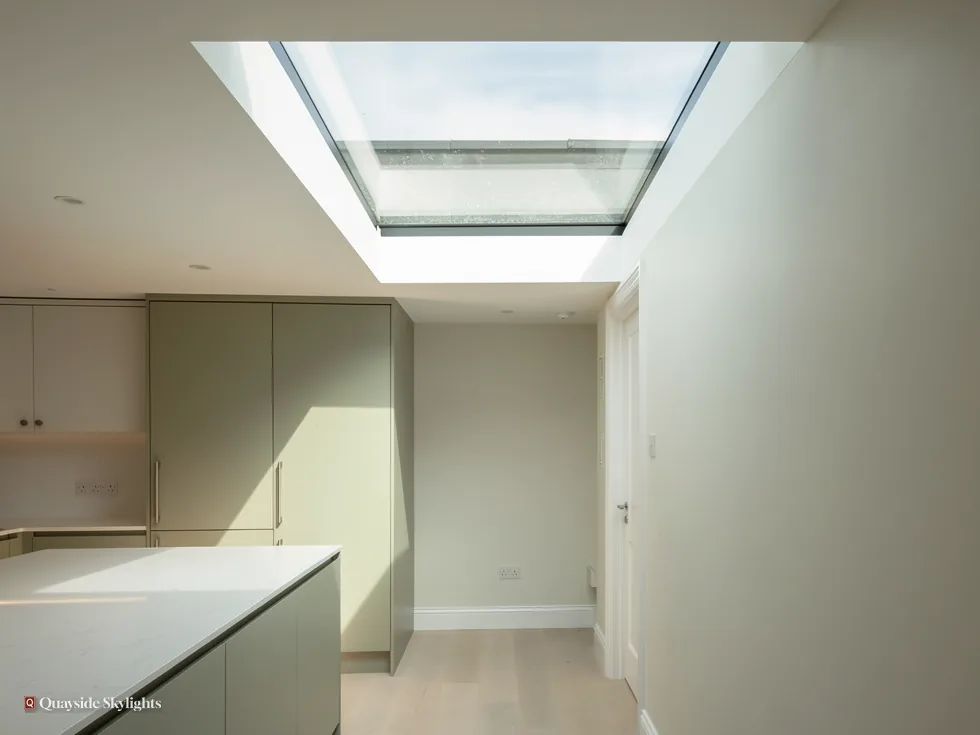
What separates a fixed unit from an opening one?
A fixed rooflight is one sealed piece of glazing in a frame. An opening one has a hinged sash that lifts clear of the frame, worked by hand or by a motor, and so has more parts to build in.
On the roof, the two can look almost identical when shut. The difference is in what is inside the frame. A fixed rooflight is a sealed glazing unit held in a frame that never moves. There is nothing to wear, nothing to adjust and one perimeter seal to get right.
What the opening version adds
An opening flat rooflight has a sash, which is a glazed panel that hinges or slides away from the frame. It needs hinges or an actuator, a second seal where the sash closes on the frame, and a way of being worked from below. Some lift at one edge, some rise on parallel arms, and some slide across. Each is a mechanism sitting in the weather, so each depends on good seals and sound fixings.
Deciding before the opening is cut
The choice shapes the hole. An opening sash needs its upstand and frame to be accurate, because a sash that cannot seat evenly will not close tight. It also needs clear space on the ceiling side for the controls, and a power route where the unit is motorised. These are far easier to plan before the roof is cut than afterwards. If you already own a fixed rooflight and are wondering about turning it into an opening one, our page on changing a fixed rooflight to open covers what is and is not possible.
Where the opening sits
Position matters as much for air as the size of the sash. A unit over the middle of a kitchen pulls steam from the spot where it forms, while one tucked at the far edge may only stir the corner. If the room has a door or window on the opposite side, opening both gives the air a clear run through. A rooflight above a stair can draw warm air up through the whole house, which is welcome in summer and unwelcome in a cold spell. These are things to decide with the drawing in front of you.
The question underneath
The real question is what you want the glass to do. If it is purely there for light, fixed is simple and complete. If it is also there for air, or for getting through, the extra parts have a purpose. The next chapters take those purposes one at a time.
What does a rooflight that opens actually give a room?
It lets warm, damp or stale air leave from the highest point in the room, can add a way onto the roof, and gives some control over summer heat. It does not add more daylight than a fixed unit of the same size.
Warm air rises, and a flat rooflight sits at the very top of the room. Open it, and the warmest air has a way out without being pushed. With a window or door open lower down, a gentle flow can start, drawing cooler air in at one level while the heated air leaves at another. That is the main case for an opening unit, and it is a physical effect, not a sales promise.
Steam and cooking smells
Kitchens and bathrooms fill with moisture, and moisture is the thing that builds up on cold glass and plaster. An opening rooflight over a kitchen island or a shower area gives that moisture a way out right where it collects. It does not replace an extractor where one is called for, but it reduces how long damp air hangs about under the ceiling.
Summer heat
A well-glazed rooflight gathers sun, and a room with a lot of glass can warm quickly. Letting that heat leave through the top is one answer. Solar control glass is another, and the two can be used together. For the glazing side of that choice, see our page on solar control glass for rooflights.
Getting onto the roof
Some opening units are made large enough to climb through, and are sold as roof access hatches. They suit a flat roof that needs to be reached for maintenance by whoever owns it. A standard ventilation unit is not built for that, and a hatch is not built for the best light, so it is worth knowing which job the opening part is meant to do. Say so at the survey and the unit can be chosen for it.
Where a fixed rooflight comes out ahead
Fixed units are simpler, have fewer places for water to enter and carry a slimmer frame. They suit rooms where daylight is the goal and ventilation is already handled another way.
Nothing moves, so nothing can stick, jam or wear out at the hinges. A fixed frame is also slimmer than one built to receive a sash, which gives a little more glass for the same opening and a cleaner line against the ceiling.
Fewer seals, fewer joints
An opening rooflight depends on two seals, one round the frame and one where the sash lands. A fixed unit depends on one. For a roof that sees standing water or heavy rain driven across it, there is a good argument for keeping the number of joints down.
Stairwells, landings and hallways
A landing or hall seldom needs ventilation from above. Its need is light, and a large fixed pane gives that most economically. The same goes for a dining area already served by doors or windows that open. In these rooms, paying for a mechanism adds parts that nobody uses.
Planning height
On a house, the 150mm projection limit under Class C counts what stands above the roof. An opening unit with a deep sash and frame can stand taller than a slim fixed one on the same upstand, so a fixed unit is the safer way to stay within permitted development. On a Tyneside flat, height is not what settles the route, since planning permission is needed for any new rooflight there.
Cost and upkeep
A fixed unit usually costs less to supply, and with no moving parts it asks for less attention over the years. An opening unit adds the sash, the hardware and, if motorised, the wiring and controls. Our costs page explains what pushes a price up or down, without figures, and the real number comes only after the survey.
| Point | Fixed | Opening |
|---|---|---|
| Moving parts | None | Hinges, arms or an actuator |
| Seals | One round the frame | Frame seal plus the sash seal |
| Fresh air | None through the unit | Releases warm and damp air at the top |
| Frame depth | Slimmer | Deeper to take the sash |
| Controls | Not needed | A pole, handle, switch or sensor |
Winding, poling or pressing a button
Opening units are worked by a pole, a hand crank, a wall switch or a remote, and motorised ones can add a rain sensor. Reach, wiring and who is using the room decide which control fits.
An opening rooflight is only useful if it is easy to open. A handle that needs a stepladder will stay closed for years, whereas a unit with the right control gets used.
Manual controls
Pole-operated and crank-operated units suit a ceiling that is within reach or where a pole can be kept nearby. They need no electrical supply, which makes them simple to fit in an existing flat roof. They suit people who can reach and turn the control without strain.
Motorised units
An electric actuator opens and closes the sash from a wall switch or a remote. It suits a high ceiling, a stairwell, or anyone who cannot reach up. It needs a power supply to the roof zone, which for a new feed is a job for a qualified electrician. Our page on electric rooflights and electricians explains the split.
Rain sensors
A sensor on the glass tells the actuator to shut if rain starts, which helps with a unit that is left open while nobody is at home. It also means the unit shuts itself when the weather turns, rather than depending on someone remembering. The detail is in our write-up of rain sensors and controls.
Cleaning and reach
Opening units that tilt inward can be cleaned from inside, which is a small blessing on a roof that nobody wants to step onto. Fixed glass on a flat roof is cleaned from the outside or left to the rain. For a roof that nobody wants to step on, that difference is worth weighing.
Safety glass
Over a room, the inner pane is laminated, so a break holds together in the frame instead of falling. That holds for fixed and opening units alike, and the control position can be set so nobody has to lean across a stair to reach it.
Which rooms suit which kind?
Opening suits kitchens, bathrooms and top-floor rooms that trap warm air. Fixed suits landings, halls and rooms with plenty of other ventilation. Planning and Building Control apply to both.
Start with what the room does and where the air goes. A kitchen in a back extension runs steamy, and the flat roof above it is a natural spot for an opening unit. A shower room with no window gains most from one, because it has no other exit for damp air. A top-floor room under a flat roof often runs warm in summer, so letting the heat out helps.
Where fixed is the sensible pick
A long hallway or a stairwell mostly needs light, and a fixed rooflight over the stair gives that. Dining areas next to bifold or sliding doors have fresh air to hand. In those rooms an opening mechanism would sit mostly unused.
The rules apply either way
Whether the unit is fixed or opening, a new rooflight on a house is permitted development under Class C if it projects no more than 150mm beyond the roof plane and sits no higher than the highest part of the roof. Flats and maisonettes have no householder permitted development, so on a Tyneside flat, upstairs or downstairs, planning permission is needed from the council. Read the title or lease to see who owns the roof, and get the other owner on board before ordering. Cutting a new opening in the roof is notified to Building Control, and we handle that where the work is notifiable. Our guide to rooflight planning permission lays out each home type.
Making the call
If you are torn, picture a wet Tuesday with the room full of steam and ask whether you would want to open the roof. If the answer is yes, choose the sash. If the room is a quiet landing, choose fixed glass and spend the difference on better glazing.
Points to settle before choosing
- Does the room already have a way for steam and warm air to leave?
- Can the person using it reach the control without a ladder?
- Is there a power route if a motor is wanted?
- Would the taller frame of an opening unit still fit the height you rely on?
- Is the glass mainly for light, or for air as well?
Shut or open: the details people check
Do opening rooflights leak more than fixed ones?
An opening unit has an extra seal, so it depends on that seal sitting right. Fitted level on a sound upstand and kept free of debris, it keeps rain out. A fixed unit has one fewer joint, which is why it is the simpler option.
Can an opening rooflight be fitted in a flat roof extension that already exists?
Yes, in most cases. The opening is cut to suit, the rim is built up to the height the maker specifies and the covering is dressed round it. We read the joists at the survey, then put the figure in a written quote that holds.
Will an opening rooflight let in noise or cold when open?
Open, it lets in whatever is outside, so it is usually left closed in winter and opened on warm days. Shut, the sash sits on its seal like a fixed pane. Choose the glazing for the heat loss, and the opening for the airflow.
Does an opening rooflight need a different upstand?
The rim has to give the sash room to lift and close without catching, and it must stay level so the seal lands evenly. The maker's sheet gives the height and the width of the clear opening, and we build the rim to that. A fixed unit is less fussy about small differences.
Is an opening unit safe over a stair?
A laminated inner pane is the norm over rooms. Placing the control where it can be reached without stretching matters more than the unit itself. We talk through reach and position at the survey so the controls land in the right spot.