Guide
Rooflight rain sensors, remotes and controls explained
An electric skylight is only as easy to live with as the way you operate it. This guide covers the sensor that closes it in a shower, then the switches, handsets, apps and timers that open it, and what to settle before the order.
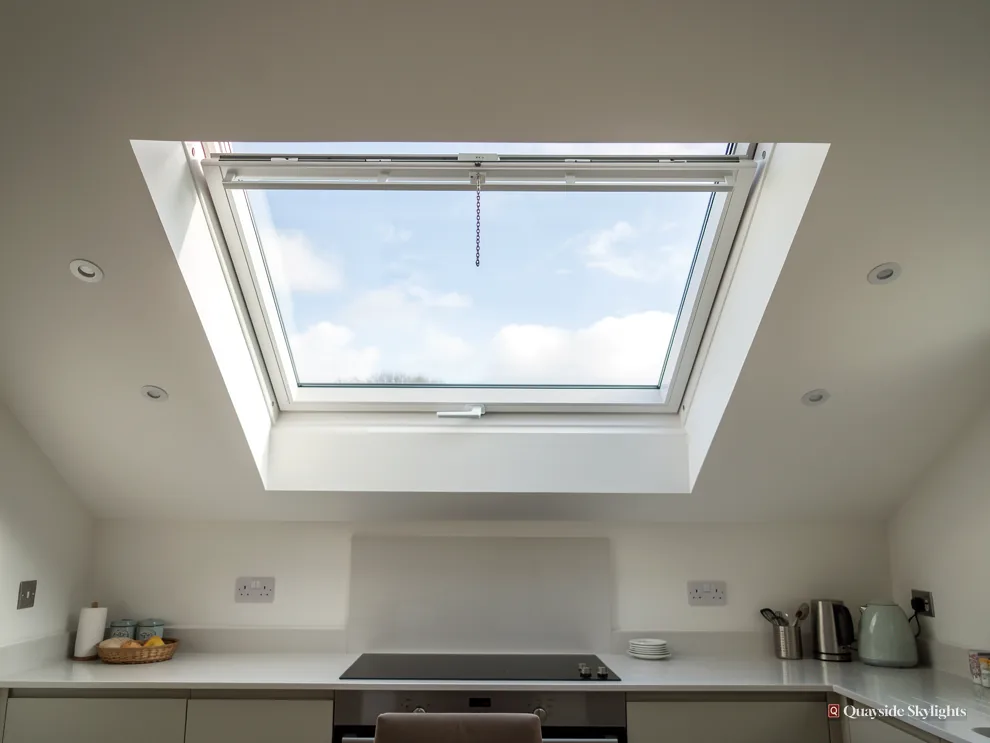
A small sensor that closes the window for you
A rain sensor tells the motor to shut the rooflight when water lands on it. It guards against the shower that arrives while the house is empty or everyone is upstairs.
Open a skylight on a warm morning, go out, and the weather has all day to change. A rain sensor is the part that deals with that. It is a small plate, often with a heated or ribbed surface, and the moment water bridges its contacts it sends a signal that overrides whatever the opening was set to do. The motor then drives the sash shut.
What it reacts to
The sensor responds to water on its own surface, not to the sky. A few drops from a passing shower can trigger it, while a damp, still mist may take longer to gather enough moisture. Some sensors include a small heating element so that they dry quickly once the rain stops, which stops a dewy morning from keeping the rooflight shut all day. Others leave you to open it again by hand or from the handset once the plate is dry.
What it does not do
The sensor is a convenience, not a guarantee. It needs power to work, so a rooflight whose supply has been switched off cannot close itself. It also cannot see wind, so a gusty day with a slanting shower can push water in during the second or two before the sash is fully home. Think of it as the thing that stops a forgotten window staying open for an afternoon, and not as a reason to leave a room unattended with the rooflight wide.
Fitted as part of the kit
On most electric systems the sensor is a matched part of the controller and motor, supplied together so they speak the same signal. Mixing a sensor from one maker with a motor from another is rarely worth trying, because the two may not talk at all.
Where on the roof should the sensor be placed?
Somewhere that gets wet when the rooflight would, and no later. A sensor tucked under an overhang or shaded by a parapet can react too late or not at all.
Because the sensor reacts to water landing on it, its position matters more than almost any other detail of the controls. The test is simple: when rain would get into the room, the sensor must already be wet.
On the glass or beside the opening
Some rooflights carry the sensor on the frame, so it sits exactly where the weather reaches the unit. Others have a separate plate fixed on the roof close to the opening, joined by a short cable. Either works, provided nothing stands between the plate and the sky. A sensor sitting in the lee of a chimney stack, a dormer cheek or a tall parapet may stay dry in a wind-driven shower while the rooflight itself is being rained on.
Pitched slopes and flat roofs
On a pitched slope, water runs off the sensor quickly, so a plate that sheds well and dries fast is an advantage. On a flat roof, water can pool, and a sensor sitting at the lowest point may stay triggered long after the shower has gone. Placement near the upper edge of the opening avoids that. If a leafy tree overhangs the roof, expect the occasional false trigger from dripping long after the rain stops.
Keeping it working
A film of dust, bird droppings or a few leaves will blunt a sensor. Wiping the plate clean with a damp cloth is all it normally takes. Because the sensor sits on the outside, choosing a spot you can reach safely from the opening or a ladder saves awkward climbs later. We look at where the weather arrives at your roof during the survey, so the position is part of the plan and not an afterthought.
Wall switch, handset or phone: which suits the house?
A wall switch is always where you expect it. A handset reaches rooflights you cannot touch. An app or hub adds timers and groups, at the cost of one more thing to keep working.
The motor will do whatever it is told. What changes day to day is how you tell it, and the choice depends on where the rooflight is and who has to use it.
The wall switch
A fixed switch by the door is the simplest control. It does not run out of batteries and it is obvious to every member of the household, including guests. It needs a cable to the switch position, which is easy to arrange in a new extension before the walls are finished and more awkward in an existing room that has already been decorated.
The handset
A radio handset needs no wiring at all, which suits a rooflight added to a finished house. One handset can drive several rooflights, and it lives in a drawer or on a wall bracket. The weak point is that handsets walk off. If a rooflight sits over a stairwell where only a pole could reach it, losing the handset leaves the window stuck.
The phone or hub
App control and smart-home hubs let you open from anywhere in the house and set a timetable. They suit a household that already runs lighting or heating from a phone. They depend on a working network, so the manual switch or handset should still be there as a fallback.
| Control | Where it works well | What to watch |
|---|---|---|
| Wall switch | New extensions and rooms mid-build | Needs a cable run to the switch |
| Radio handset | Finished rooms with no spare wiring | Easily mislaid or left flat |
| App or hub | Homes already running a smart system | Relies on network and updates |
How does the rooflight get its power?
Mains feeds a transformer, which runs a low-voltage motor, or a solar panel charges a battery in the unit. The choice sets how much cabling the room needs.
A rooflight motor is small and does not need much current. How the current reaches it is one of the decisions that quietly shapes the whole installation.
Mains-fed systems
Most electric systems take a mains supply to a control box or transformer, usually mounted in the roof void near the opening, which then feeds the motor at a lower voltage. This suits rooms where the opening is high and out of reach, because the motor is strong and always ready. The supply side is electrical work, and our answer on whether electric rooflights need an electrician sets out who does what.
Solar and battery systems
Certain units have a little solar panel feeding a rechargeable battery, so no cable runs into the room at all. That helps where chasing a cable would mean damaging a finished ceiling, as in a Tyneside flat. The trade-off is that the battery depends on the light it receives, so a rooflight on a shaded north slope is a weaker candidate than one facing the day.
Battery handsets
Whichever way the motor is powered, a handset runs on its own cells. They last a long time, but they do run down, and a spare set kept in the house saves a morning of frustration.
Our electric and opening rooflights page shows the range these systems are fitted to.
What can a timer or temperature trigger do?
Automation can open a rooflight at set times, vent a hot room when the temperature climbs and close it at night. It is useful when the controls are used often and risky if left unreviewed.
Once a rooflight has a motor and a controller, it can follow rules instead of waiting for someone to press a button. Whether that is worth having depends on the household.
Timed opening
A timer can crack a bathroom rooflight for twenty minutes after a shower, or open a landing rooflight at mid-morning to let the night's stale air out. It works best with a routine that rarely changes. On a house where one person leaves early and the other works from home, it may well clash with how the rooms are actually used.
Temperature triggers
A sensor in the room can ask the rooflight to open when the space gets warm and shut again when it cools. That is gentle protection against a south-facing extension turning into an oven while the family is out. Set the trigger too eagerly and the room is forever being aired, so give yourself a few weeks of adjusting the thresholds.
Grouping and overrides
Several rooflights can be gathered into one group, so that a single press opens the lot. Every automated system should have a clear manual override, and a lock-out mode for nights, holidays and rainy weekends. Ask who in the household will be able to change the rules, because an automation nobody understands tends to be switched off within a month.
How much air this actually moves is the subject of our guide to opening rooflights for ventilation.
What changes on a Tyneside flat or shared roof?
Cable routes, switch positions and any new opening are limited by what you own and whether the roof is shared. Check your title or lease before choosing a control.
Controls look like a small matter until the roof belongs to two households. In a Tyneside flat, your own title or lease shows who has the roof above you and what the neighbouring owner must be asked, so look at it, and have that conversation, before buying anything.
Cables across a boundary
A wall switch needs a cable, and a mains supply needs a route from a consumer unit. In a flat, that route may pass through a floor, a party wall or a ceiling that sits under someone else's home. A radio handset or a solar unit avoids the question altogether. That makes either one the neater answer for a flat.
New openings need permission
Flats and maisonettes have no householder permitted development, so a new rooflight on a Tyneside flat needs planning permission from the council. A fitted motor makes no difference to that. Our rooflight planning guide explains how each kind of home is treated, and the council for your address is named on it.
On a house
A house has more freedom, because the whole roof is normally yours and permitted development can apply to a rooflight. The usual points still apply, including Building Control: cutting a new opening is building work notified to Building Control, and we handle that where it is needed.
Settle these before choosing controls
- Where will the wall switch sit, and can a cable reach it?
- Who in the home will use the handset, and where will it live?
- Is the sensor placed where the weather reaches the rooflight first?
- Does a manual override still work if the power or network fails?
- Have you checked the title or lease for the roof and the other owner?
What should the quote say about controls?
It should name the sensor, the control type, how the motor is powered and what happens in a power cut, so that nothing is left to be chosen on the day.
Because controls are small parts of a bigger order, they are the easiest thing to leave vague. A free survey comes first and then a quote in writing with the price fixed, so the details need settling before that price is set.
Read the specification line by line
Look for the make of the motor, the type of sensor and where it will be fixed. Look for the control: a wall switch, a handset, or an app. If more than one rooflight is being fitted, ask whether each has its own control or whether they work as a group. A quote that says only 'electric opening' leaves all of that to be decided later.
Ask about the power cut
Every motor system should have a way to close or open the rooflight when the power fails. Some have a manual crank or a key release, others a back-up battery. Find out which, and where the tool lives. A rooflight that cannot be shut during a storm and a power cut is a bigger problem than one that opens by hand.
Costs and what moves them
Controls add to the cost of the rooflight, and the add-ons stack up. The page on what moves a rooflight price sets out the factors without numbers, and the survey turns them into one figure for your house.
Control choices people raise before ordering
Will a rain sensor close the rooflight if the power is off?
No. The sensor sends a signal, and the motor needs power to act on it. A solar and battery unit can carry on for a while without mains, but it depends on how charged the cell is. Ask about the manual release for storm nights.
Can I add a rain sensor to a rooflight that already has a motor?
Sometimes, if the motor and controller are of a type that accepts one. Many systems are sold as a matched set, so the answer depends on the maker and model. We can look at the existing system at the free survey and tell you what it takes.
Do I need an app to run an electric skylight?
No. A wall switch or a radio handset runs the motor without any app, network or account. An app suits households that already use one for heating or lighting and want timers on top of the basic controls.
Is a heated sensor worth having?
It dries faster after a shower, so the rooflight is free to open again sooner. On a sheltered roof or a skylight that is rarely left open, a plain sensor may be plenty. We talk through the choice at the survey.
Can one handset run several rooflights?
Yes, on most systems. You can pair each rooflight to the handset individually or group them so one press moves them all. If a handset is lost, a replacement can usually be paired again, which is worth checking when you order.