Guide
Walk-on rooflight load and slip ratings, in plain figures
Two numbers decide whether a walk-on rooflight suits your house: how much weight the glass is designed to carry, and how well its surface grips a shoe. This guide explains both, and what paperwork should back them up.
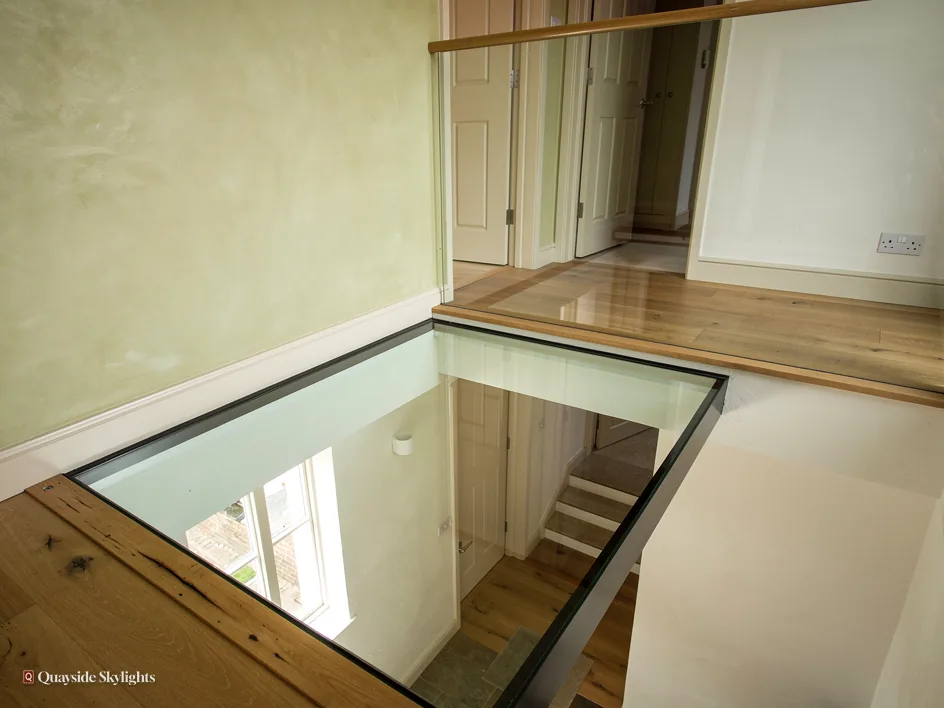
What does a load rating actually describe?
It states the weight per square metre, and the concentrated weight in one spot, that the glass and its frame are designed to carry safely. It is set by the use you intend, not by the glass alone.
A load rating is a design statement. It says that the glass, the way it is laid up, and the supports around its edges have been calculated for a particular amount of weight, with a safety margin on top. Change the use, and the statement changes with it.
Two kinds of weight
Engineers look at weight in two ways. The first is spread load: the combined weight of people, furniture or stored items across a whole square metre, written in kilonewtons per square metre. The second is point load: a concentrated force in a small patch, such as a heel, a table leg or the foot of a ladder, written in kilonewtons. A pane can pass comfortably on spread load and still need to be checked against a point load, because a narrow heel puts far more pressure on the surface than a flat sole does.
Why the use comes first
A rooflight that someone steps across now and then to reach a flat roof has a very different duty from a glass floor in a kitchen that is crossed every day. A terrace with a table, chairs and a few guests is different again. The maker or the engineer asks what will actually happen on the glass, then designs for that and for a safety margin beyond it. If a supplier quotes a load figure without asking what the glass will be used for, treat the figure with caution.
Glass is only part of the rating
The frame, the seating and the structure under the opening all take part. A strong pane resting on a weak kerb or an unsupported edge does not carry the rated load. That is why the rating belongs to the whole assembly: glass, frame, seals, supports and the structure that receives them. When we survey a house, the structure around the opening is as much part of the answer as the glass itself.
How do you match the glass to how it will be used?
Describe the real use to the maker: occasional stepping, daily crossing, furniture, or a gathering of people. Each calls for a different design duty, and the quote should name which one it is built for.
Sorting your own use into a clear category is the most useful step you can take before any glass is ordered. It takes ten minutes and saves a specification that is either too light or needlessly heavy.
Light duty: stepping across now and then
This covers a rooflight set in a flat roof where somebody walks over it to reach a hatch, a chimney or a gutter. Nobody stands on it for long and nothing is placed on it. The glass is still laminated and designed for a person's weight, but the design allowance is lower than for a floor.
Everyday duty: a floor you cross daily
A walk-on rooflight in a hallway floor, a kitchen extension or a landing is used like any other part of the floor. People cross it, stop on it, and put chairs near it. The design has to allow for a steady pattern of use and for the weight of whatever stands on or beside it.
Gathering duty: a terrace or a party
Where people stand together, move furniture or dance, the load assumptions go up. A roof terrace with a rooflight set in it is the classic case, and the terrace and balcony answer covers what that adds.
The table sets the three side by side and gives you the question to put to the supplier for each.
| Use of the glass | What it has to cope with | Question for the supplier |
|---|---|---|
| Stepped over now and then | One person at a time, no furniture, short moments | Is it designed for foot traffic or for access only? |
| Crossed every day | Steady footfall, chairs, a rug, an occasional dropped item | Which floor loading is the design based on? |
| Part of a terrace or entertaining space | Groups, tables, planters, heels and moved furniture | Does the point load cover a table leg or a heel? |
How is the slipperiness of glass measured?
Labs use a pendulum test. A rubber slider swings across the surface, wet or dry, and the reading shows how much it grips. Guidance treats a reading of 36 or above as a low risk of slipping.
Slip resistance sounds subjective, but it can be measured. The method most often quoted for floors in the UK is the pendulum test, set out in British Standard 7976 and used throughout the flooring world.
How the test works
A pendulum arm carries a small rubber slider. It swings down and brushes across a patch of the surface, and a scale records how much the surface slowed it. A slippery surface slows it very little and gives a low reading. A grippy one slows it more and gives a high reading. The test is run on the finished surface, wet and dry, so the number belongs to a specific finish, not to glass in general.
Reading the number
The UK Slip Resistance Group publishes guidance on what the results mean. A pendulum test value of 36 or more is generally treated as a low potential for slip. Between 25 and 35 is moderate, and below 25 is high. Plain polished glass, tested wet, scores poorly, which is why walk-on glass is never left untreated.
One result, one finish
A test certificate is for the sample that was tested. If the supplier changes the dot pattern, the etch depth or the coating, the result can change with it. Ask for the certificate that matches the finish on your quote, tested in wet conditions, and keep a copy with the other papers for the house.
For how that grip holds up in weather, read the wet-weather grip answer.
Which surface finishes give glass its grip?
Fired ceramic dots, acid etching, sandblasting and applied coatings each add texture. They differ in how much light they let through, how they look from below and how they behave when cleaned.
Glass gets its grip from a treatment applied to the upper face. Four are in regular use, and none is best everywhere. They trade grip, light and appearance against each other.
Fired ceramic dots
A pattern of small dots of ceramic enamel is printed on the glass and fused to it in the toughening furnace. The dots stand slightly proud and give the shoe something to bite on. Because they are part of the glass, they do not peel. They also cut a little daylight, and the dot pattern is visible from underneath as a faint speckle.
Acid etching and sandblasting
Acid etching gives a fine satin texture across the whole face. Sandblasting roughens the surface mechanically, often in a pattern. Both give an even look from below and soften the view through the glass, which some owners welcome over a bedroom or a bathroom. They can hold marks, so they ask more of the cleaning routine.
Applied coatings and films
A grit-bearing coating or an adhesive film adds grip after the glass is made. It can be a sensible choice for a rooflight that is already in place and being upgraded, but it is a surface layer that can wear, so a fired or etched finish is better for a floor crossed every day.
Choosing between them
Think about who walks on it and how it will be seen. A pattern that looks right from the room above may look busy from the cellar or hall below. Ask to see a sample of the exact finish held up to the light before you sign the quote, because a small chip on a bench tells you more than a catalogue picture.
What paperwork should come with the glass?
A statement of the design load and the use it assumes, a slip test certificate for the finish, and the build-up of the glass. These belong with the quote, and Building Control is notified before the opening is cut.
A walk-on rooflight is a structural element as well as a window, so it comes with documents, and a sound supplier gives them without being chased. Ask for them while you are comparing quotes, not after the glass is ordered.
The design statement
This gives the intended use, the spread load and the point load the glass is designed for, the span it covers and the edge supports it assumes. If the use on paper is lighter than the use you have in mind, say so before anything is made.
The slip certificate
A pendulum reading taken in wet conditions shows the grip figure belongs to the surface on your quote. The certificate should name the build-up, or tie back to it.
The build-up
The sheet should list each layer of glass, the interlayer between them, and the edge treatment. The glass thickness answer explains what each layer does and why the stack is far deeper than a window pane.
Notification and guarantee
Cutting a new opening in a roof or floor structure is building work, and it is notified to Building Control, either the local authority or a registered building control approver. Sending that notification is our task once the survey has fixed the design. The installation comes with a written guarantee on workmanship lasting ten years, and the price set after the survey stays fixed. Terms are on the guarantee page.
Every option is on the walk-on rooflights page; for a survey, use the quote form.
Before you accept a specification
- The use on paper matches how the glass will really be used
- Both a spread load and a point load are stated
- A wet pendulum result is supplied for the exact finish
- The layers and thickness of the build-up are listed
- The structure around the opening is covered in the design
Rating questions that come up before an order
Can a single rooflight carry both people and furniture?
Yes, if it is designed for that use. The design load must cover the spread weight of people and furniture and the point load under a table leg or heel. Tell the supplier the real layout so the glass is not specified for foot traffic alone.
Does a higher load rating mean thicker, clumsier glass?
It means extra layers, thicker layers or closer supports, though the result is not always bulky. Opening width counts for as much as load: firm supports let a short span carry plenty on slim glass, where a long span asks for deeper glass.
Is a slip rating the same indoors and outdoors?
No. The number belongs to a finish tested under set conditions, and weather changes how a surface behaves. Moss, frost and wet leaves lower the grip on any outdoor glass, so an exposed rooflight deserves a stronger finish and a regular wipe-down.
Do I need a new slip test if the glass supplier changes?
Ask for the certificate that matches the finish you are being sold. A different maker's dot pattern, etch depth or coating can give a different result, so a certificate for another product tells you little about the one on your quote.
Who decides the load the glass is designed for?
You describe the use. The supplier or an engineer converts that into a design load and records it in the specification ahead of manufacture. Tell us if plans change later, because the glass may need respecifying.