Guide
Rooflight U-values and Part L, explained for an existing home
A U-value is the number that says how much warmth a rooflight lets slip away. This guide explains the scale, the two limits in Part L, why a glass unit and a whole unit give different figures, and how to read a quote.
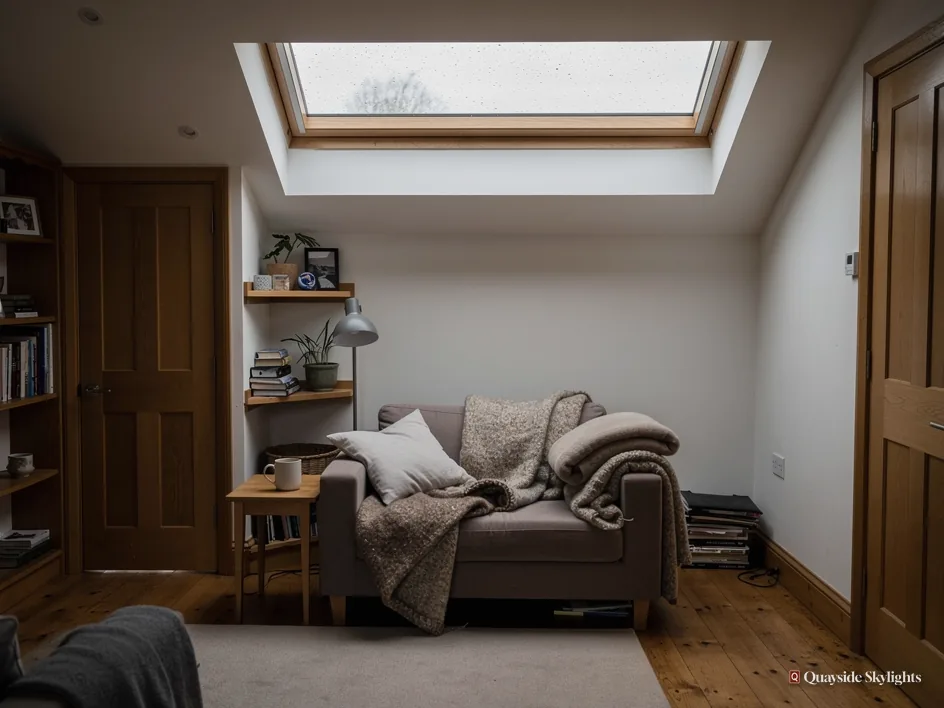
What does a U-value actually measure?
A U-value shows how quickly heat passes through a building element. The lower the figure, the more slowly warmth escapes, so a lower number means a better insulating rooflight.
Every part of a home's outer shell lets some heat through: walls, floors, doors, windows and roofs. The U-value puts a number on how much. It is written in watts per square metre for each degree of temperature difference, shortened to W/m²K. Fit a rooflight over a landing and the figure tells you how many watts leak through each square metre of it for every degree between the warm room and the cold air outside.
Lower is better
The direction of the scale catches people out because most ratings in daily life run the other way. A high U-value means heat escapes quickly. A low value means the unit holds warmth in. Think of the figure as leakiness and you will not go wrong. A well insulated pitched roof has a very low value. Glass, even very good glass, sits well above it, and that gap is the reason a rooflight deserves more thought than a patch of plasterboard and slate.
What the figure leaves out
A U-value describes heat loss and nothing else. It does not say how much daylight gets through, how much of the sun's heat arrives, or whether water will form on the glass. A unit can have an excellent figure and still make a south-facing loft room uncomfortable in July. Our answer on solar control glass in a rooflight covers the heat that comes in, which the U-value ignores.
Why one number is never the whole story
The same product can carry several U-values, depending on what was measured. Manufacturers publish figures for the glass alone, for the glass in its frame, and sometimes for the frame fitted into a kerb. When you compare two datasheets, make sure each refers to the same thing, or one will look better only because it counted less.
Which limits does Part L set for a rooflight?
For existing dwellings in England the limiting U-value is 2.2 W/m²K for a rooflight and 1.4 W/m²K, or WER Band B, for a roof window. A roof window has to do better.
Part L of the Building Regulations covers the conservation of fuel and power. For existing dwellings in England, it sets the limiting U-value at 2.2 W/m²K for a rooflight, and at 1.4 W/m²K, or Window Energy Rating Band B, for a roof window. These are ceilings, not targets: a unit whose figure is above the limit does not comply, and one below it does.
Rooflight or roof window?
The two words sound alike, but Part L treats them as different products. The roof window is the unit set into a pitched slope, normally opening or pivoting, in the timber or PVC frames familiar from loft conversions. A rooflight is the wider family: fixed flat rooflights, lanterns and glazed panels over flat roofs. The rooflight limit is looser because these products are often built from different materials and sit on a separate upstand. The roof window limit is tighter because the whole unit is tested as a window.
Where the limit bites
The limit applies to the unit you are fitting, so it comes into play when you add a rooflight and when you replace an old one with a new one. A new opening in a roof counts as building work, so notice goes to Building Control, meaning the local authority or a registered building control approver. Sending it is part of our job, with the datasheet for your unit attached.
Beyond the minimum
Meeting 2.2 or 1.4 means a unit is lawful, not that it is the best you can fit. A unit that clears the limit comfortably is a better buy for a room you sit in all winter, such as a kitchen extension, than one that scrapes over the line.
| Product | Limiting figure | What it covers |
|---|---|---|
| Rooflight | 2.2 W/m²K | Flat rooflights, lanterns and glazed panels on an upstand |
| Roof window | 1.4 W/m²K, or WER Band B | A window set in the plane of a pitched roof |
| Neither | No daylight rule for houses | Part L is about heat, not the amount of light |
Why does one rooflight show two different figures?
The centre of the glass loses less heat than the edges and the frame. A quoted figure for the pane alone will look better than the figure for the finished unit, so ask which one you are reading.
Open a rooflight datasheet and you may find two numbers that look like contradictions. They are not. One describes a slice of the product, and the other describes all of it.
The pane in the middle
The centre-pane value looks at a patch of glass away from any edge. It reflects what the coatings, the gas fill and the gap between the panes do. It is the most flattering figure, and manufacturers like to lead with it because glass is what they are proudest of.
The edge of the glass
Where two panes meet the frame, a spacer holds them apart. A metal spacer carries heat across the gap more readily than a warm edge spacer made from a less conductive material. That makes the rim of the glass colder than its middle, and on a cold morning it is where condensation tends to show first. A better spacer pulls the edge value up towards the centre.
The frame and the kerb
Frames add their own loss. A slim aluminium frame lets heat pass more easily than a thicker thermally broken one, and a lantern with a lot of glazing bars has a lot of frame. For a flat rooflight, the kerb it stands on counts too. A poorly insulated upstand can let the heat go round the unit instead of through it, however good the glass is.
Which figure the law uses
The limits in Part L apply to the whole unit, so the figure that matters is the overall value for the product as installed. When a quote gives only a centre-pane number, ask the supplier for the overall value in writing. Our quote names the unit and gives its overall figure, so the number you sign against is the number that was assessed.
Do the rules differ for a flat and a house?
The U-value limits are the same. The planning route is not: a house usually has permitted development for a rooflight, while a flat does not and needs planning permission.
Part L does not care whether your home is a flat or a house. A unit that meets the limit in a terrace in Heaton meets it just as well above a Gateshead semi. What changes between the two is the permission to fit it at all.
On a house
A rooflight on a house is permitted development under Class C of Part 1 of Schedule 2 of the General Permitted Development Order 2015. It qualifies if it projects no more than 150mm beyond the plane of the roof slope and sits no higher than the highest part of the roof. An Article 4 direction, or a condition on an earlier planning permission, can remove Class C from a house.
On a flat
Flats and maisonettes have no householder permitted development. In planning terms a Tyneside flat is a flat on either floor, which means a new rooflight in one has to go through a planning application to the council. Ownership of the roof is a different question. Each flat's title or lease holds the answer, including whether the neighbour has to agree, so look there and talk to them before you order anything.
Why it belongs in a U-value guide
A better unit is often taller, with a deeper frame or a thicker kerb, and height decides which planning route applies. The rooflight planning permission guide walks through each type of home. Pick the product and the permission route in the same conversation.
How do I compare U-values on two quotes?
Compare like with like: the same product type, the same kind of figure and the same kerb detail. Ask for the overall U-value of the installed unit, not only the glass.
Two quotes can both say they meet Part L and still describe very different products. A few questions put them on a level footing before you decide.
Same measure, same product
Check each quote names the product, its size and the kind of U-value it gives. A figure for a double glazed fixed rooflight cannot be set beside one for an opening roof window, because the limits and the construction differ. If one says centre-pane and the other says overall, the first will always look better and tell you less.
Both limits are caps
A unit at 2.2 W/m²K for a rooflight, or 1.4 W/m²K for a roof window, just passes. Anything under that has headroom. For a room that stays warm all winter, such as a kitchen or a bathroom, the extra headroom is worth a conversation. For a stair landing that is only passed through, the minimum may do the job.
What sits around the unit
A good unit on a badly insulated kerb gives away what the glass saves. Ask what the kerb or lining is made from, how it is insulated, and how the roof covering is dressed up to it. The cost depends partly on this, and our page on what moves the price explains how.
Putting it in writing
After the free survey, the fixed written quote names the unit, its size and its overall figure, and the sum on it holds unless the work itself changes. You then have a document to set any rival quote beside. The wider set of choices, from glass to frames, is laid out on the energy efficient rooflights page.
Put these on the table when comparing quotes
- Is the figure for the glass alone or for the whole unit?
- Does it say rooflight or roof window, with the matching limit?
- What is the kerb or lining made from, and how is it insulated?
- Is a warm edge spacer named, or only the type of glass?
- Is the figure written down in the quote, not only said aloud?
Quick answers on U-values
Is a lower U-value always better?
For heat loss, yes. A lower figure means warmth escapes more slowly. It does not tell you about daylight, summer heat or condensation, so use it alongside the other facts about the unit. For a south-facing loft room, the glass coating counts alongside the number.
What is WER Band B?
WER stands for Window Energy Rating. It scores a roof window on heat lost and heat gained together and gives a band letter. Part L accepts a roof window at 1.4 W/m²K or in WER Band B, so either route can show a unit complies.
Does a new opening have to be notified?
Yes. Cutting a new opening in a roof is building work, notified to Building Control: the local authority or a registered building control approver. Where the work is notifiable we send it in, with the figures for the chosen unit attached.
Do old rooflights meet today's limits?
Older units, especially single glazed or early double glazed ones, tend to sit well above the current limits. A new unit is judged against the limit for its type when it goes in, so the replacement is where the improvement shows up.
Where can I read the rules myself?
The government publishes Approved Document L on gov.uk, and the Planning Portal explains permitted development for householders. Both are good starting points, and our guarantee page describes what we put in writing for the work itself.